Daylight saving time sounds like a clock problem.
For staffing agencies, it is a payroll, billing, scheduling, compliance and client-service problem — one that resurfaces twice a year and rarely gets fixed in between.
Most of the year, an eight-hour shift is an eight-hour shift. Then the clocks change, and the systems responsible for tracking that shift stop agreeing with each other. The employee worked one number of hours. The client approved another. The VMS recorded something else. Payroll calculated a fourth. That is when one hour becomes far more expensive than one hour.
The issue is more relevant right now because Congress is once again deciding whether the United States should stop changing clocks at all. On July 14, 2026, the House passed the Sunshine Protection Act, which would make daylight saving time permanent across most of the country. The bill still needs Senate approval before it can become law, and its path there is uncertain — a similar measure cleared the Senate in 2022 and was never taken up by the House.
For staffing agencies, ending the clock changes would remove a recurring operational exception. Until that happens — and it may not happen this year — agencies still need to manage what occurs every spring and fall.
When Eight Hours Are Not Eight Hours
The problem is easiest to see on an overnight shift.
When daylight saving time begins in the spring, clocks move forward at 2 a.m. An employee scheduled from 11 p.m. to 7 a.m. may only work seven actual hours. When daylight saving time ends in the fall, the clock repeats an hour. That same employee may work nine actual hours.
The Department of Labor specifically recognizes that overnight employees work one hour less during the spring transition and one additional hour during the fall transition. Employees generally must be paid for the hours they actually work.
That sounds simple until the employee is working for a staffing client. The staffing agency may have promised eight hours of coverage. The client may have budgeted for eight billable hours. The employee may expect eight hours of pay. The timekeeping system may record seven or nine. Everyone can be acting reasonably and still end up with different expectations.
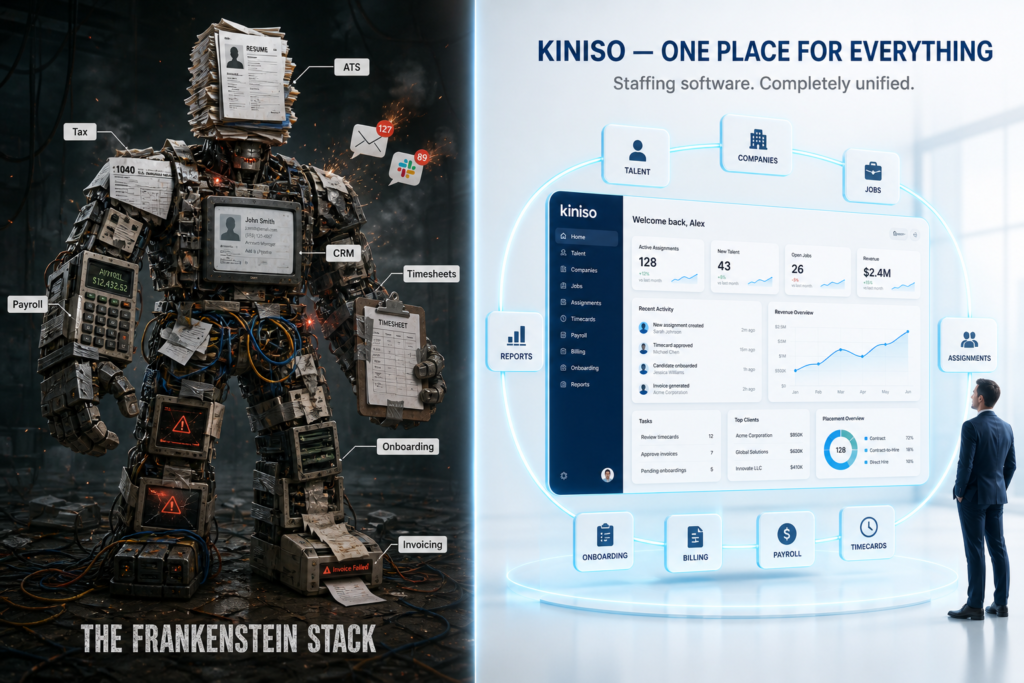
The Real Problem Is the Number of Systems Involved
A typical staffing shift may be recorded in several places at once:
- The employee’s time clock
- The client’s workforce management system
- A vendor management system
- The staffing agency’s ATS or staffing platform
- The payroll system
- The billing system
Some of those systems use local time. Others convert timestamps to Coordinated Universal Time. Some calculate elapsed time between punches. Others rely on the scheduled shift length regardless of what actually happened.
During the fall transition, a time such as 1:30 a.m. occurs twice. Unless every system is configured properly, one platform may recognize both instances while another treats the second as a duplicate and discards it.
The result may be an employee paid for nine hours while the client approves eight. It may be an invoice for eight hours when nine were actually worked. It may be a payroll exception that someone has to investigate manually three days after the shift occurred, once the discrepancy finally surfaces. The dollar amount on any single shift is minor. Multiplied across hundreds or thousands of overnight workers, it becomes a real payroll and margin issue.
One Additional Hour Can Also Create Overtime
The repeated hour in the fall doesn’t exist outside the normal workweek. If that extra hour pushes a nonexempt employee above 40 hours, it may need to be paid at the overtime rate. Under the Fair Labor Standards Act, covered nonexempt employees generally receive at least one and one-half times their regular rate for hours worked beyond 40 in a defined workweek.
That means the agency may not simply be absorbing one additional straight-time hour. It could be paying overtime — including any compensation that must be included in the employee’s regular rate — while attempting to convince a client that an apparently eight-hour shift should be billed as nine.
This is where the language in the staffing agreement matters. Does the client pay for scheduled hours, approved hours, actual elapsed hours or guaranteed shift hours? Many agreements never answer that question, because it only becomes visible during a small number of overnight shifts each year — easy to overlook until it isn’t.
Scheduling Confusion Creates Coverage Problems
Payroll is only one side of the issue. Clock changes also affect interviews, shift reminders, transportation, on-call schedules and centralized recruiting teams.
An employee who arrives one hour late to an office job creates an inconvenience. An employee who arrives one hour late to a hospital, warehouse, production line or distribution center may leave a critical position uncovered.
Automated communications can make the problem worse. A reminder generated by the ATS may reflect one time zone while the client’s calendar invitation reflects another. A recruiter working from a different state may schedule an interview based on the wrong offset.
Most states follow the federal daylight saving calendar, but Hawaii, most of Arizona and several U.S. territories do not observe daylight saving time. That means the time difference between offices can shift during the year even when neither location changes its normal working hours. For a local staffing agency, this is easy to manage. For a national company with centralized payroll, recruiting or service teams, it introduces another layer of exceptions to track.
Fatigue Is Also a Staffing Issue
The spring transition does more than change timestamps. It reduces the available sleep window for many workers. Research using workplace injury data has found an increase in injuries and injury severity on the Monday following the spring move to daylight saving time. Other research has found short-term negative effects on both working life and personal life following the transition.
This matters most in the environments staffing firms commonly serve. A fatigued office worker may be less productive. A fatigued employee operating a forklift, driving to a jobsite, caring for patients or working around industrial equipment creates a genuine safety concern.
Staffing firms cannot control how much sleep an employee gets. They can control whether reminders are clear, whether supervisors expect more errors that week, and whether overnight coverage has been reviewed before the transition hits.
Permanent Daylight Saving Time Would Simplify Operations
If the current proposal becomes law, the public debate will center on morning darkness, evening sunlight, schools and sleep. For staffing companies, the operational effect would be more straightforward. Eliminating the clock changes would mean:
- Fewer overnight payroll exceptions
- Fewer disputed timecards
- More consistent interview scheduling
- Fewer calendar and reminder errors
- Simpler coordination between time zones
- Less disruption for overnight employees
It would not eliminate time-zone complexity. Arizona, Hawaii and other exempt jurisdictions would still require attention, depending on the final legislation. There would also be a one-time implementation burden — staffing companies would need to confirm that payroll systems, time clocks, VMS integrations, calendars, shift templates and client communications had all been updated correctly. The change would remove a recurring problem, but only after everyone agreed on the new rules.
What Staffing Agencies Should Do Now
The safest approach is not to wait for payroll to discover the issue after the fact. Before each clock change, agencies with overnight employees should identify the affected assignments and determine:
- How the timekeeping system will calculate elapsed time.
- Whether the employee is paid for scheduled or actual hours.
- How the client will approve and pay for the shift.
- Whether the additional fall hour could create overtime.
- Whether any shift reminders or transportation arrangements need to be adjusted.
- Which system is treated as the final record when timestamps conflict.
The agency should also test its technology rather than assuming the software handles the transition correctly. Modern payroll and staffing platforms should understand daylight saving time. That does not mean every integration, configuration or client system will produce the same result.
The Broader Lesson
Daylight saving time is not one of the largest problems in staffing. It is a useful example of how staffing problems actually develop.
A small exception crosses several systems. Each system follows its own rules. The employee, client and staffing agency all have different expectations. No single discrepancy looks serious until payroll is late, an invoice is rejected or an employee is paid incorrectly.
Changing the clocks may take one minute. Getting payroll, billing, scheduling and client expectations to agree on what happened can take much longer.
Frequently Asked Questions
Does daylight saving time affect employee pay for overnight shifts?
Yes. The Department of Labor generally requires employees to be paid for hours actually worked. An overnight employee works one fewer hour during the spring transition and one additional hour during the fall transition, regardless of what the scheduled shift length shows.
Can the daylight saving time change trigger overtime?
It can. If the extra hour created during the fall transition pushes a nonexempt employee above 40 hours in their defined workweek, that time is generally owed at the overtime rate under the Fair Labor Standards Act.
Has Congress passed a law to end daylight saving time changes?
Not yet. The House passed the Sunshine Protection Act on July 14, 2026, which would make daylight saving time permanent nationwide. The bill still requires Senate approval and a presidential signature before it becomes law.
Which states don’t observe daylight saving time?
Hawaii and most of Arizona do not observe daylight saving time, along with several U.S. territories. This creates additional scheduling complexity for staffing agencies operating across multiple states or time zones.
What should staffing agencies check before each clock change?
Agencies should confirm how their timekeeping system calculates elapsed time, whether pay is based on scheduled or actual hours, how overtime thresholds are affected, and which system is treated as the authoritative record when timestamps between platforms disagree.