Most staffing software was not built to run a staffing company. It was built to run the back end of one. That distinction matters more than it sounds like it should.
Traditional staffing software is genuinely good at the operational work that happens after a candidate, client, and job already exist. It stores employee records, tracks assignments, handles onboarding, connects to payroll and billing, and manages timecards, invoices, compliance, and reporting. All of that is necessary. But it leaves a fairly large question unanswered: how do you actually create the next assignment? That is where the Frankenstein tech stack begins.
Staffing Software Keeps Growing New Parts
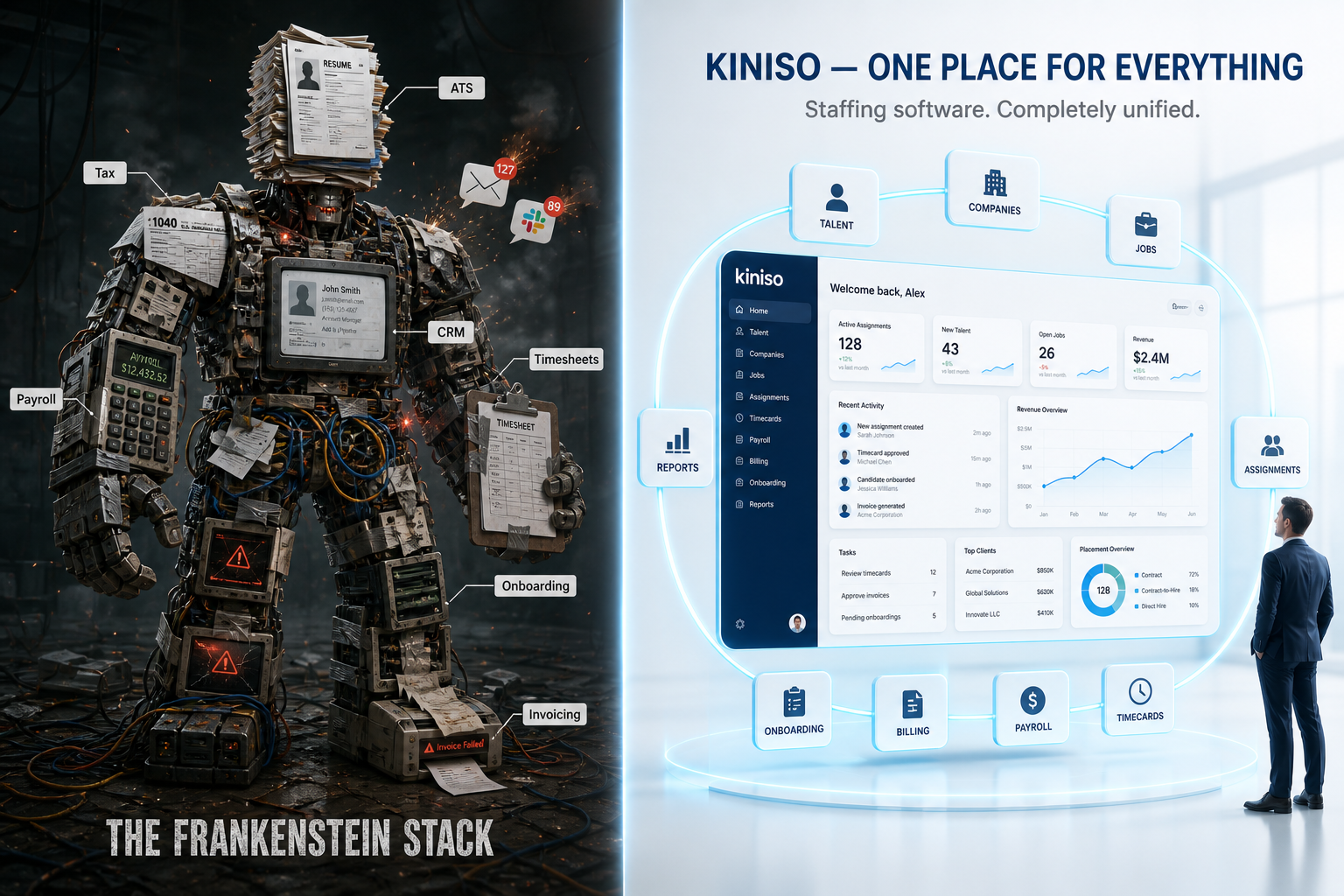
A staffing company buys an ATS. Then it needs a CRM. Then email tools, then texting, then sourcing tools, then job boards, then sales intelligence, then automation, then sequencing, then analytics, then AI. Eventually you have ten systems technically connected to one another, but very few of them were designed around the way a staffing company actually works.
The problem is not that any individual tool is bad. The problem is that the workflow was never really designed. It just, accumulated. Each new problem gets solved by bolting another piece onto the monster. Need more candidates? Add a sourcing platform. Need recruiters to communicate faster? Add texting. Need better sales activity? Add a CRM. Need sales leads? Add another database. Need recruiters to rediscover old candidates? Add AI search. Need people to use all of it consistently? Add automation. Eventually your staffing software starts to look less like an operating system and more like a laboratory experiment.
Even Recruiting Became Something We Had to Bolt On
This is particularly strange when you think about recruiting, which is supposedly the core function of a staffing company. Yet many staffing firms still depend heavily on external job boards and sourcing platforms to find candidates. Part of the answer is that most staffing databases were built to store candidate records, not understand candidate intent, and there is a major difference between the two.
A database can tell you that Jane Smith is a medical assistant. It may tell you where she worked, what she made, when she last worked for you, and which recruiter entered her into the system. But what you really want to know is whether Jane is looking right now, whether she’ll work in Arlington, whether she’ll take $23 an hour, whether she can start Monday, whether she wants full-time work, whether she’d consider a contract assignment, and whether anything has changed since the last time anyone spoke with her. Those are not resume questions. They are intent questions, and when staffing software makes that information difficult to capture, update, and search, every new job order becomes a brand-new search.
So recruiters go somewhere easier. They go back to Indeed, ZipRecruiter, LinkedIn, or whichever external database lets them type in what they need and see people who appear to be available right now. The irony is that the staffing company may already have thousands, tens of thousands, or hundreds of thousands of candidates sitting inside its own ATS. But if searching those people requires too much effort, the ATS becomes a system of record instead of a source of talent. That’s incredibly expensive not just in dollars, but in time.
Sales Has the Same Problem
Sales may be worse. A lot of staffing sales is still built around hunting and pecking: pick a company, look it up, find a contact, call, send an email, log the activity, move to the next company, then repeat the process tomorrow. There is nothing inherently wrong with prospecting one company at a time. The problem is that the software encourages activity without necessarily encouraging planning.
Good salespeople do not just need a list of companies. They need a reason to call. They need patterns, context, and a clear sense of where the staffing company already has an advantage. If three experienced forklift operators are available Monday, that should immediately create a sales workflow around companies that hire forklift operators. If the team suddenly has five medical assistants available in North Dallas, that should create a focused list of clinics, urgent care centers, specialty practices, and healthcare employers that could use those people. If an assignment with ten warehouse workers just ended, sales should already know which nearby companies are hiring similar workers before those employees disappear into another staffing firm’s database. That is planning.
Instead, staffing salespeople often work from static lists, old CRM records, Google searches, LinkedIn searches, job postings, and whatever companies happen to come to mind that morning. The result is activity without concentration. The system tracks the calls. It does not necessarily help determine which calls should happen.
Staffing Software Should Reward Focus
The real opportunity is to turn staffing sales into a workflow instead of a habit. Imagine opening a system and seeing twelve warehouse candidates available this week, then forty-three companies within fifteen miles that employ similar workers, then eighteen that have posted warehouse jobs recently, then seven that are existing or former clients, then four that have already spoken with the company in the past year. Now the salesperson is not hunting. They are working a market, and that is a fundamentally different activity.
The software, in this version, is helping the person think. It is helping them prioritize. It is helping recruiting, sales, and service work from the same information, and it creates something most staffing firms struggle to develop consistently: institutional memory.
Every Search Should Not Start From Zero
Staffing companies generate an enormous amount of useful information every day. Candidates tell recruiters where they have worked. Employees tell service teams which companies are hiring. Clients tell salespeople what skills are difficult to find. Recruiters learn which pay rates candidates will accept. Salespeople learn which companies use staffing firms. Operations learns where turnover is increasing. But much of that knowledge stays inside individual conversations, and six months later someone needs the same information again. Sometimes they look at the old order to grab former candidates. Most just post the job and start searching again.
That is one reason job boards remain so deeply embedded in staffing. Job boards make the next search easy. They give recruiters a fresh pool of people who have recently raised their hands. A staffing company’s ATS may contain a far larger pool of people, but unless it makes intent easy to update and easy to search, historical data becomes progressively less useful. The industry often describes this as a database problem. It is really a workflow problem. The database does not just need more information. It needs your staff to be present mentally, because the software rewarded them for doing so, instead of just being a warehouse of old records.
Then AI Arrived to “Save Time”
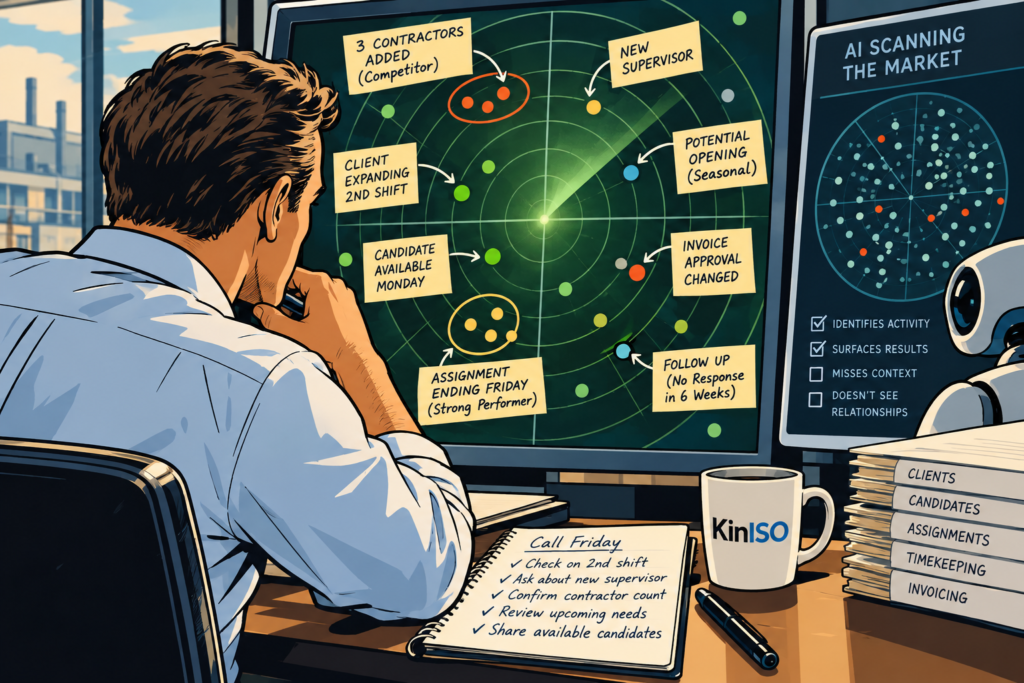
Now there is another layer on top of all of this. AI companies are promising to do more of the work automatically: write the email, research the prospect, generate the call script, summarize the conversation, score the candidate, recommend the company, send the follow-up, update the CRM. The pitch is always that you’re freeing up time for your recruiters to do real work.
Real work is putting candidates at job sites. Full Stop.
There is certainly work worth automating. Nobody needs a salesperson manually copying phone numbers between systems, and nobody benefits from recruiters spending half the day formatting notes. But there is another side to the equation: work is also how people learn. A recruiter who speaks with thirty candidates starts remembering the market. A salesperson who researches fifty companies starts recognizing industries, competitors, hiring patterns, locations, and decision-makers. A service manager who regularly talks with employees starts seeing turnover problems before they appear in a report. Those repetitions create judgment, memory, and context.
If software does all of the research, writes all of the messages, summarizes all of the calls, and decides what happens next, the employee may become faster while becoming less knowledgeable. They are present for less of the process. They remember less of the market. They understand less about why the recommendation exists in the first place. Eventually, this risks creating something staffing companies already know does not work particularly well: a salesperson with a script. They know what to say. They just don’t know why they’re saying it.
The Better Staffing Tech Stack Does Not Replace Thinking
The goal of better staffing software should not be to remove people from the work. It should remove friction from the work, and those are two very different goals. Good technology should help recruiters remember candidates. It should help salespeople see markets. It should connect candidate availability to client demand. It should turn conversations into usable data. It should make previous work easier to find instead of forcing every search to begin again. And it should help employees focus their attention instead of outsourcing it entirely.
The staffing companies that win will not necessarily be the ones with the most automation. They will be the ones whose technology makes their people better at recruiting, sales, and service. That is a very different goal than simply saving time.
Key Terms
ATS (Applicant Tracking System): Software used to store candidate records, track them through the hiring or assignment process, and manage the paperwork and compliance tied to placements. Built primarily for record-keeping rather than active candidate search.
CRM (Customer Relationship Management): Software used to track sales contacts, companies, communication history, and pipeline activity. In staffing, it’s typically the tool salespeople use to log calls and manage prospecting lists.
Candidate intent: Real-time information about what a candidate is currently looking for — availability, location preferences, pay expectations, and openness to different types of work — as opposed to static resume data about where they’ve worked in the past.
Frankenstein tech stack: A collection of separately purchased tools (ATS, CRM, sourcing platforms, job boards, texting, automation, AI) that are technically connected but were never designed around a single, coherent workflow.
Programmatic job advertising: Automated distribution of job postings across job boards and platforms, with budget and placement adjusted based on performance data.
Institutional memory: Knowledge gained from recruiter, salesperson, and service conversations that stays useful and searchable over time, rather than being lost once the conversation ends.
Frequently Asked Questions
Why do staffing companies rely so heavily on job boards instead of their own ATS? Because job boards make searching for available candidates easy, while many ATS platforms make it hard to capture and update whether a candidate is currently looking for work. A large ATS database is only useful if intent data is easy to search — otherwise recruiters default to the tool that gives them the fastest answer.
What’s the difference between a staffing database and a staffing workflow? A database stores information about candidates and clients. A workflow connects that information to action — for example, surfacing available candidates and automatically identifying which nearby companies are hiring for similar roles. Most staffing software does the first well and the second poorly.
Does AI solve the Frankenstein tech stack problem? Not by itself. AI tools are often added as another layer on top of an already fragmented stack, automating tasks like email writing or call summaries without addressing the underlying workflow gaps. In some cases, heavy automation can reduce how much recruiters and salespeople actually learn about their own market.
What should staffing companies look for in a better tech stack? Software that connects candidate availability directly to client demand, turns recruiter and sales conversations into searchable data, and helps employees prioritize which calls to make — rather than just tracking the calls they’ve already made.
Is more automation always better for staffing sales and recruiting? No. Automation is useful for eliminating repetitive manual work, like copying data between systems. It’s less useful — and potentially counterproductive — when it replaces the research and conversation that builds a recruiter’s or salesperson’s market knowledge over time.