There’s a version of recruiting you read about online: AI agents, automated screening, predictive matching, one-click workflows. Then there’s temporary staffing.
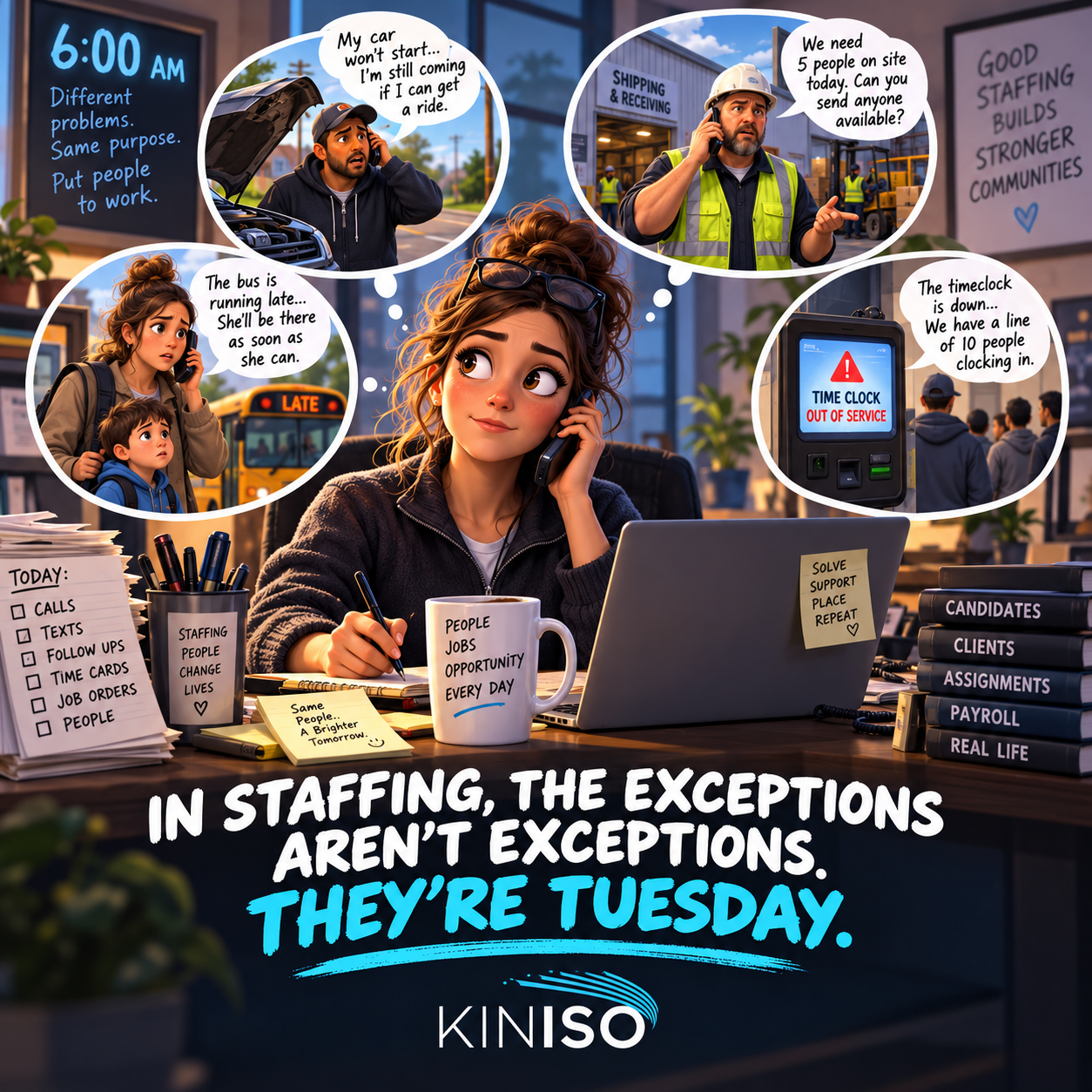
Temporary staffing is finding out at 6:12 a.m. that the bus route your employees depend on is running late, and suddenly seven people may not make the start of a shift. It’s having eight people marked “available” in your system, only to realize the new jobsite is 20 miles away and three of them don’t have reliable transportation.
It’s an employee whose car won’t start. A parent whose child missed the school bus. A timecard that wasn’t approved because the client has a new manager who never received the link. A workers’ compensation code entered incorrectly that somehow turns into ten hours of detective work on a Tuesday.
This is what staffing firm owners deal with every day. And it’s why the idea that AI is going to simply “take over recruiting” feels very different once you spend real time around temporary staffing companies.
AI Is an Enabler, Not a Replacement
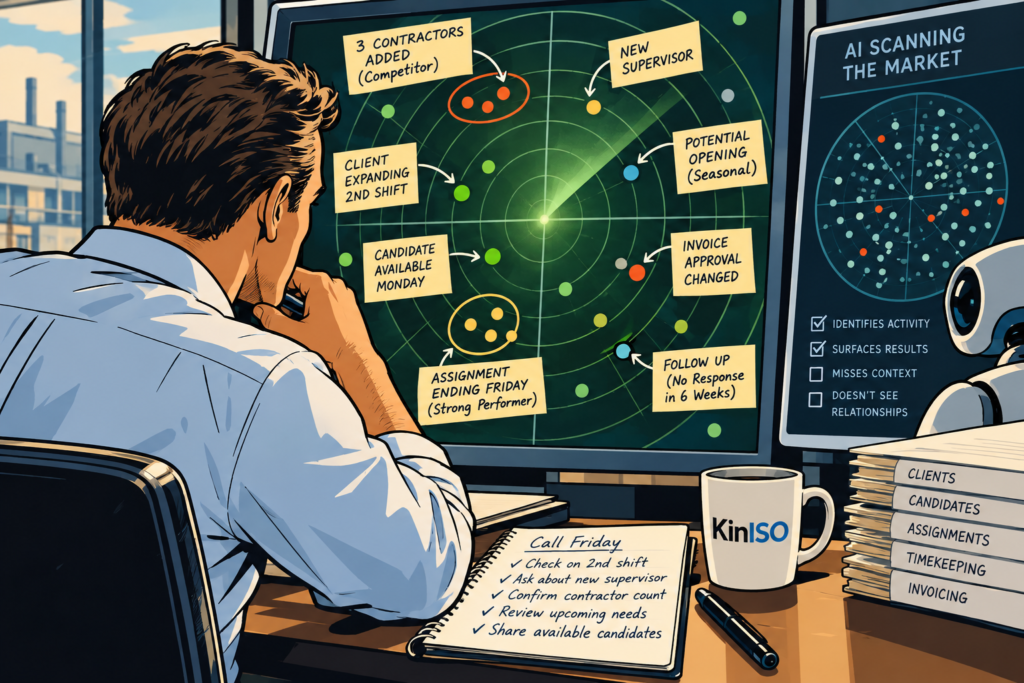
AI absolutely matters. It can help recruiters search faster, communicate faster, organize information better, and spot things humans might miss. But AI is an enabler. It’s terrible at nuance, and has never heard of an exception. And temporary staffing is largely a business of exceptions.
Someone still has to figure out how Maria gets to the plant when her car breaks down. Someone has to notice that the employee who said he could work second shift actually lives an hour away. Someone has to call the client when payroll is approaching and the supervisor still hasn’t approved the hours. And someone has to decide whether the person who disappeared yesterday deserves another chance today. Those decisions rarely fit neatly into a workflow.
Years ago, HR and talent acquisition leaders would get on conference stages and tell stories about the exceptions. There’s always the employee they bent the rules to help, the candidate they personally called, the manager who stepped outside the process because it was the right thing to do. Those were usually the stories people remembered.
In staffing, those stories aren’t exceptions. They’re Tuesday.
What This Means for Technology
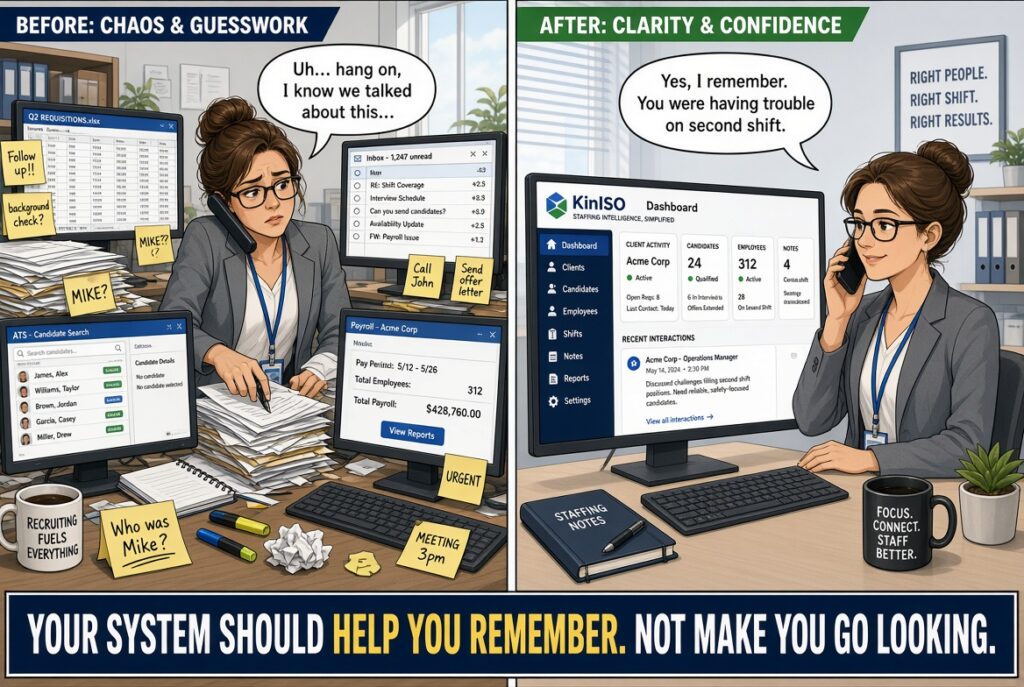
That matters when we think about technology. The goal shouldn’t be to remove people from staffing. It should be to remove enough administrative friction that recruiters, salespeople, and service teams have more time to deal with the things software cannot predict.
When something breaks in temporary staffing, someone isn’t simply having a bad user experience. They’re about to miss a paycheck, a production target, or a medical appointment for a child balanced against a parent who may not know how they’re getting to work on-time tomorrow.
Staffing firm owners don’t need a seminar about putting the human back into Human Resources. They’ve been doing it every morning before most of us finish our first cup of coffee. That’s the perspective we try to keep in mind when building technology at KinISO.
Frequently Asked Questions
Will AI replace staffing recruiters?
No. AI can speed up search, screening, and communication, but temporary staffing runs on exceptions — a canceled bus route, a no-show, a client whose supervisor changed overnight. Those situations require judgment and relationships, not automation.
What’s the real difference between AI recruiting tools and staffing operations software?
AI recruiting tools are built to speed up matching people to jobs. Staffing operations software has to handle everything that happens after the match — timecards, compliance, payroll issues, transportation problems, and the daily logistics of keeping shifts filled. One is about finding people. The other is about keeping them working.
How should a staffing firm actually use AI?
As a way to remove administrative friction, not as a way to remove people. AI works best when it frees up recruiters and service teams to spend their time on the problems that can’t be predicted or automated — the ones that show up every morning.
What does “exception-based work” mean in staffing?
It refers to the daily, non-standard problems that don’t fit a workflow: transportation breakdowns, timecard disputes, client changes, no-shows. In temporary staffing, these aren’t rare edge cases — they’re the core of the job.
Is KinISO an AI recruiting platform?
KinISO builds technology for staffing firms with the understanding that software should reduce administrative burden, not replace the people who solve problems software can’t predict.
Terminology
Exception-based work — The day-to-day, non-repeatable problems in staffing operations (transportation issues, timecard errors, client changes) that require human judgment rather than automated workflows.
Enabler technology — Software designed to make people faster and more effective at their jobs, as opposed to software designed to replace the people doing the job.
Administrative friction — The manual, repetitive tasks (data entry, status updates, routine follow-ups) that consume recruiter and service team time without requiring judgment.
Predictive matching — AI-driven systems that attempt to forecast candidate-to-job fit based on historical data and patterns, commonly marketed as a core AI recruiting capability.
Back-office operations — The compliance, payroll, timekeeping, and administrative functions that keep a staffing firm running behind the scenes, distinct from front-line recruiting and sales.