One of the easiest mistakes in staffing sales is believing that because you know a client, you still know the client.
You remember the hiring manager. You know what they usually hire. You know the pay range, the shift, the location, and the kind of person who tends to work well there.
Then two months go by.
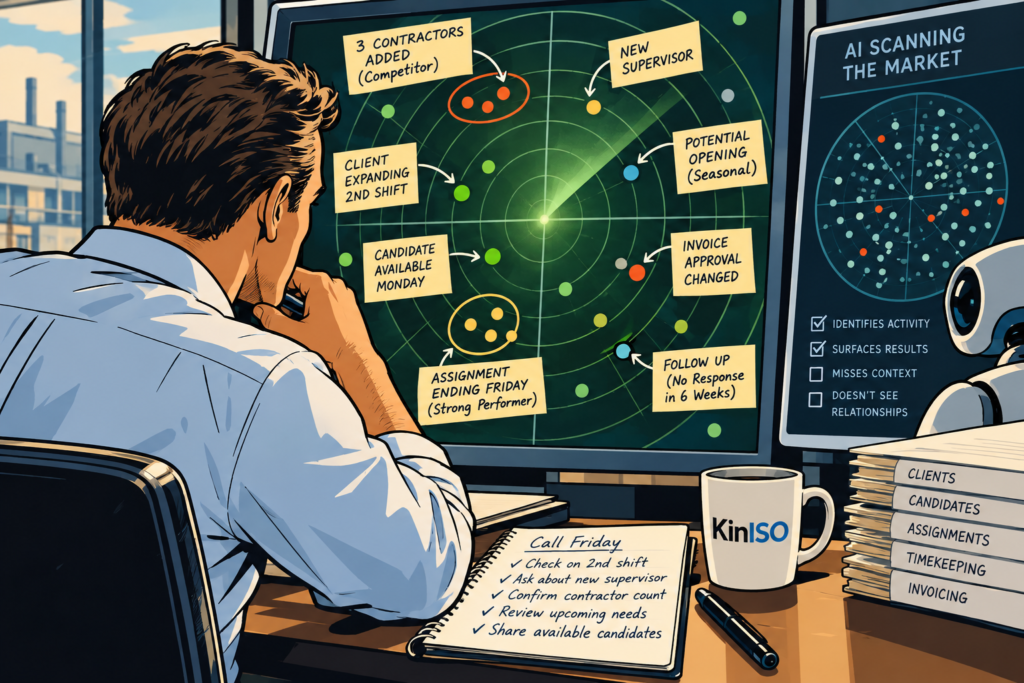
A competitor puts three people on assignment. A supervisor leaves. Overtime starts climbing. A new plant manager changes the hiring process. One department freezes headcount while another suddenly cannot find enough people.
None of that may show up in your CRM.
That is the problem with relying too heavily on digital knowledge. The information can be accurate and still be incomplete.
Your CRM Knows What Happened. You Need to Know What Is Happening.
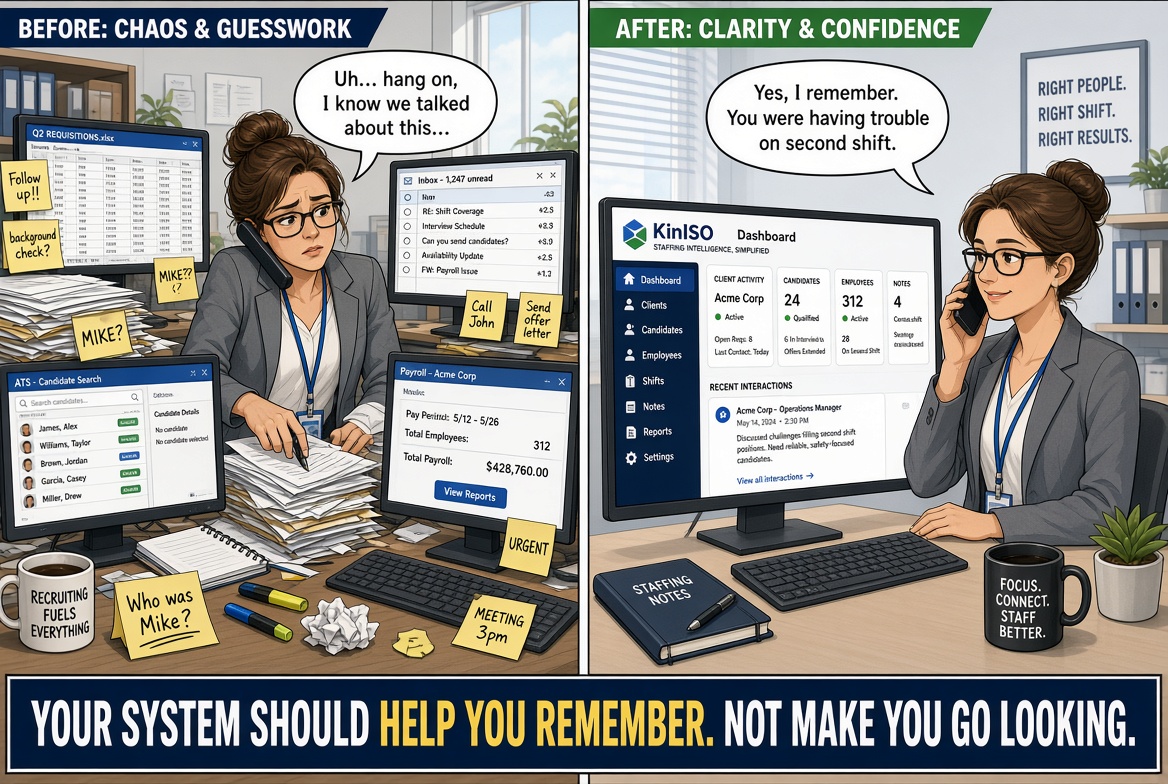
Staffing software is very good at helping you remember facts.
It can tell you when you last called a client. It can show you open orders, previous placements, bill rates, notes, contacts, activity, candidate history, and outstanding tasks.
What it cannot do by itself is tell you what the client feels like today.
That comes from conversation.
A sales rep who calls regularly starts hearing the small details that rarely make it into formal systems.
“Second shift is getting hammered right now.”
“Mike is leaving at the end of the month.”
“We have three people out on leave.”
“Corporate wants us to stop paying overtime.”
“The last person you sent us was exactly what we needed.”
Those details matter because staffing demand usually appears in real life before it appears in a requisition.
By the time the job order exists, everyone can see it.
Your advantage comes from knowing what is developing before the order is opened.
Out of Sight Really Does Become Out of Mind
Clients are busy.
They are not sitting around wondering which staffing company they should call next.
They call the person they remember.
That means staying visible matters, but simply sending another automated email is not necessarily visibility.
There is a difference between appearing in someone’s inbox and being present in their business.
“Just checking in” does very little.
Compare that with this:
“I remembered you mentioned your second shift was having attendance problems. We just finished an assignment with someone nearby who has been working that schedule for the last two years. Is that still something you’re dealing with?”
That is a different conversation.
The second salesperson sounds like someone who has been paying attention.
Because they have.
Real Details Make Outreach Believable
AI has made it extremely easy to create polished outreach.
That is useful.
It has also made polished outreach increasingly meaningless.
You can scrape a company website, read a LinkedIn profile, summarize a press release, identify a hiring trend, and generate a perfectly professional email without actually knowing anything meaningful about the business.
The result often sounds personalized without feeling personal.
Real life is messier.
A real salesperson remembers that the client hates interviewing on Mondays.
They remember that the warehouse gets crushed before the holidays.
They know the supervisor who will take a chance on someone with a gap in employment.
They know that one branch cares about speed while another will wait three days for a stronger candidate.
They know that the client says they want five people when experience suggests they really need eight because three will not make it through the first week.
That kind of knowledge does not come from better prompting.
It comes from paying attention.
Being Present Is Part of the Job
There is another reason this matters.
Memory is built through attention.
If you are half-listening to a client while reading email, reviewing a dashboard, or waiting for an AI transcript to summarize the call later, you may technically capture the information without actually learning it.
That distinction matters.
The strongest staffing salespeople develop a mental model of their clients.
They do not just remember individual facts. They understand how those facts connect.
They know who influences whom.
They know what creates urgency.
They know which departments are stable and which ones are constantly fighting fires.
They know when a manager says, “We’re probably fine,” that it may mean, “Call me again Thursday.”
That level of understanding develops because someone was mentally present during dozens of conversations.
Technology can preserve the notes.
It cannot replace the attention required to understand them.
The Best Outreach Starts Before You Write It
Good outreach is often treated as a writing problem.
It is usually an information problem.
If your message sounds generic, the answer is not always a better subject line, a smarter sequence, or another AI-generated variation.
Sometimes you simply do not know enough.
Call the client.
Ask what changed.
Talk to the employees you already have working there.
Ask your recruiter what candidates are saying.
Look at who started, who quit, who stayed, and where the process keeps breaking down.
Then write the message.
The words become easier when you actually have something to say.
Technology Should Make You More Aware, Not Less
The purpose of staffing technology should not be to remove you from the business.
It should help you stay closer to it.
KinISO gives staffing teams one place to see the activity around clients, candidates, employees, orders, onboarding, time, payroll, billing, and communication.
That matters because context gets lost when information is scattered across different systems.
But the software is still only part of the equation.
The real advantage comes when good technology supports a salesperson who is paying attention.
The system remembers the details.
You remember what they mean.
And when the next client need appears, you are not introducing yourself again.
You were already there.