Most staffing software does not fail because it lacks features. It fails because people never fully change the way they work.
A new system gets implemented. Users attend training. They learn where everything is, see the major features, and are told how the new workflow is supposed to operate.
Then real work starts.
A recruiter gets busy. A process does not work exactly the way they expected. Someone cannot remember how to complete a task. Under pressure, people tend to revert to whatever they already know.
That is why staffing software adoption requires more than training people to use a system. At KinISO, customer success is about helping staffing firms build better ways of working, one successful action at a time.
Customer Success Is Not a Retention Strategy
Customer success is often treated as a function of account management. Keep customers engaged. Answer support questions. Conduct regular check-ins. Make sure the customer renews.
Those things matter, but retention should be the result of customer success, not its definition.
The better question is simple: Is the customer getting meaningful value from the system?
That value has to show up in the work.
Are recruiters completing tasks faster? Are managers getting better visibility? Are employees spending less time entering the same information twice? Is the staffing firm eliminating workarounds that developed because its previous system could not support the way the company actually operates?
When customers can see those improvements for themselves, staffing software adoption becomes much easier.
Start With an Action, Not a Feature
Traditional software training often starts with the system.
Here is the dashboard. Here are the menus. Here is how candidates work. Here is how orders work. Here is reporting. Here are 40 other things you might eventually need.
We prefer to start with the user.
What are you trying to accomplish today? What part of your current process is taking too long? Where are people doing unnecessary work? What are they doing outside the software because they do not know there is a better way?
Then we solve one of those problems.
Not ten of them.
One.
The goal is to help the user perform a specific action correctly and immediately see why it is better.
Once that happens, the software stops being something the customer was told to use. It becomes something that helped them solve a problem.
That distinction matters.
Confidence Comes Before Complexity
Software adoption is cumulative.
When a user learns one workflow and it makes their day easier, they become more willing to try the next one. When the next recommendation works too, confidence grows again.
That changes the customer relationship.
Instead of customer success constantly pushing people to use more features, users begin asking better questions.
“Can KinISO do this?”
“Is there a faster way to handle this?”
“How should we set this up?”
Those are much more useful conversations because the customer is no longer learning software in the abstract. They are improving an operating process.
That is when customer success becomes less about instruction and more about optimization.
Good Training Reinforces What Already Works
There is another problem with traditional training: people forget.
Someone can understand a workflow perfectly during a one-hour Zoom session and still revert to an old habit three days later.
That does not necessarily mean the original training was bad. It means behavior change requires reinforcement.
As we introduce new workflows, we also look back at the earlier ones. A screen share can quickly show whether the original process is still being followed or whether an old workaround has returned.
This makes each customer success interaction cumulative.
The first conversation might require a detailed walkthrough. The next might require only a short explanation. Eventually, a screenshot or brief video may be enough.
The customer is not simply becoming better at KinISO. They are developing a better understanding of how their staffing operation should work.
Success Should Be Visible
One of the most important principles behind our approach to customer success is that users should not have to take our word for it.
If we recommend a different workflow, there should be a reason.
It should save time. Remove unnecessary steps. Improve visibility. Reduce duplicate work. Make follow-up easier. Help someone make a better decision.
The user should be able to see the result.
That creates a much stronger form of staffing software adoption than telling someone, “This is the correct way to use the software.”
People rarely change established work habits simply because a software company tells them to. They change when the new behavior produces a better outcome.
Staffing Software Should Fit the Staffing Firm
This philosophy also influences how we think about the product itself.
Staffing firms should not have to rebuild their entire operation around a generic software workflow. The system should make sense to the people actually running a staffing business.
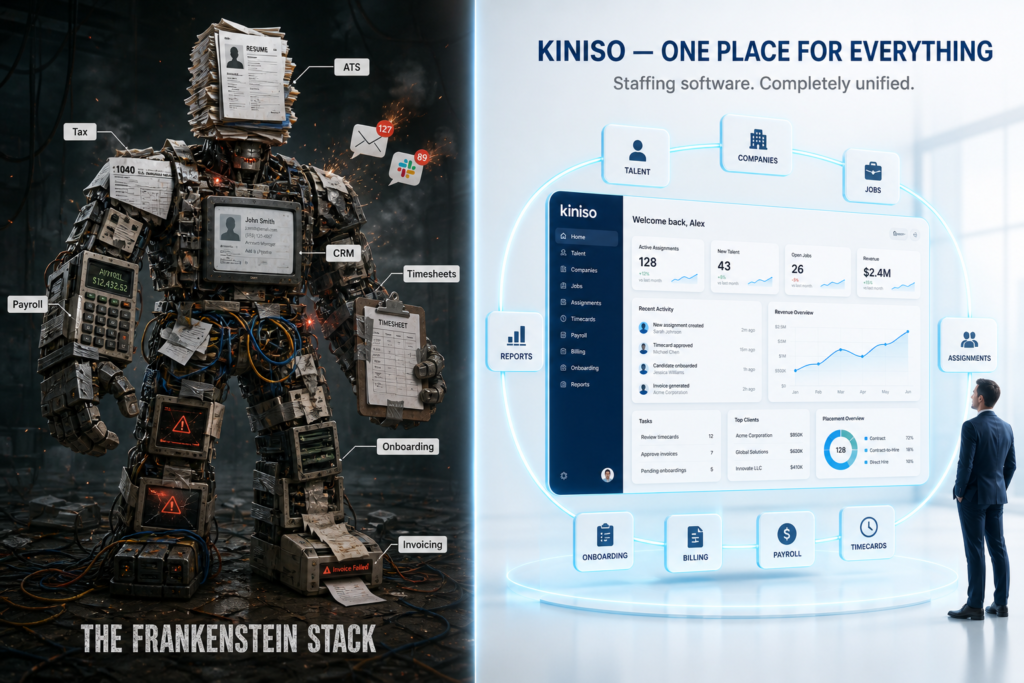
That is particularly important for firms that have spent years using systems built primarily around back-office functions, with recruiting and sales tools added later.
KinISO was built around the staffing workflow itself: the daily interactions between recruiters, salespeople, employees, clients, jobs, assignments, and the back office.
When staffing professionals see the system, the goal is not for them to learn an entirely new language.
The goal is for the workflow to look familiar, then show them where it can be better.
One Successful Action at a Time
There is no single training session that creates software adoption.
There is no feature checklist that creates customer success.
The process is much simpler, although doing it well requires discipline.
Find something the customer needs to accomplish. Help them do it correctly. Make sure the result is visible. Reinforce the behavior. Then solve the next problem.
Success builds on success.
Over time, customers stop thinking about whether they are “using the software correctly.” The system simply becomes the way the work gets done.
That is the customer success philosophy we are building at KinISO.
If your staffing software feels more like a back-office system with a CRM attached to it, take a look at KinISO. We can show you what a staffing platform looks like when the workflow starts with the way staffing firms actually operate.
Definitions
Customer Success
Customer success is the process of helping customers achieve measurable value from a product or service. At KinISO, that means more than answering support questions. It means helping staffing firms improve the way work gets done using the software.
Staffing Software Adoption
Staffing software adoption is the point at which recruiters, salespeople, managers, and back-office employees consistently use a staffing platform as part of their normal workflow. Logging into a system is not adoption. Adoption occurs when the software becomes the preferred way to complete the work.
Staffing Workflow
A staffing workflow is the sequence of activities involved in running a staffing firm, including sales, recruiting, candidate management, job management, onboarding, assignments, timekeeping, billing, payroll, and client communication.
Back-Office Staffing Software
Back-office staffing software primarily manages operational functions such as employee records, assignments, timekeeping, payroll, billing, and compliance. Some systems later add recruiting and sales functionality around that original back-office architecture.
Staffing CRM
A staffing CRM manages relationships and activity involving prospects, clients, candidates, and contacts. In many staffing platforms, CRM functionality overlaps with applicant tracking and recruiting workflows.
Software Training
Software training teaches users how a system works. Customer success goes further by helping users determine how to apply the system to their actual work and produce a better result.
Frequently Asked Questions About Staffing Software Adoption
Why do staffing firms struggle with software adoption?
Staffing firms often struggle with software adoption because employees already have established ways of working. If a new system makes a task confusing, slower, or unfamiliar, users frequently return to spreadsheets, email, notes, or the previous process. Successful adoption requires showing users that the new workflow produces a better result.
Is software training enough to create user adoption?
Usually not. Training can explain how a system works, but knowing how to use software and consistently using it are different things. Adoption requires repetition, reinforcement, and visible benefits from changing the way a task is performed.
How can a staffing firm improve software adoption?
Start with a specific workflow that matters to the user. Identify a problem, show the user how to solve it in the system, confirm that the new approach works, and reinforce that behavior before adding more complexity. Adoption becomes easier as users accumulate successful experiences.
What should customer success look like for staffing software?
Customer success should focus on the customer’s actual staffing operation. That means understanding how recruiters, salespeople, managers, and back-office teams work, identifying inefficient processes, and helping users get measurable value from the software.
What is the difference between customer support and customer success?
Customer support generally responds when a user encounters a problem. Customer success is more proactive. It looks for ways customers can use the software more effectively, eliminate unnecessary work, improve workflows, and achieve better operating results.
How is KinISO different from traditional staffing software?
KinISO is designed around the operating workflows of staffing firms, connecting recruiting, sales, employees, clients, jobs, assignments, and back-office functions. Our customer success approach follows the same philosophy: start with the work the customer needs to accomplish and use the software to make that work easier.