When staffing firms compare software platforms like TempWorks, Avionté and KinISO, the conversation almost always starts with features. Does it run payroll? Does it include an ATS? Can recruiters track candidates through a pipeline? Is there a CRM built in? Can it generate an invoice?
Those are reasonable questions, and every serious staffing platform will answer yes to most of them. But feature checklists tend to obscure a more important difference between these systems, which is how each one was actually built. TempWorks and Avionté have been serving staffing firms for decades, and both built their reputations on back-office systems capable of handling the genuinely complicated work of assignments, timekeeping, payroll and billing. As the market began to expect modern, browser-based recruiting and CRM tools, both companies evolved their platforms to meet that demand. KinISO arrived on the scene considerably later, which gave it the advantage of building on modern cloud technology from day one and designing sales, recruiting and back-office functionality as parts of a single platform rather than stitching them together after the fact.
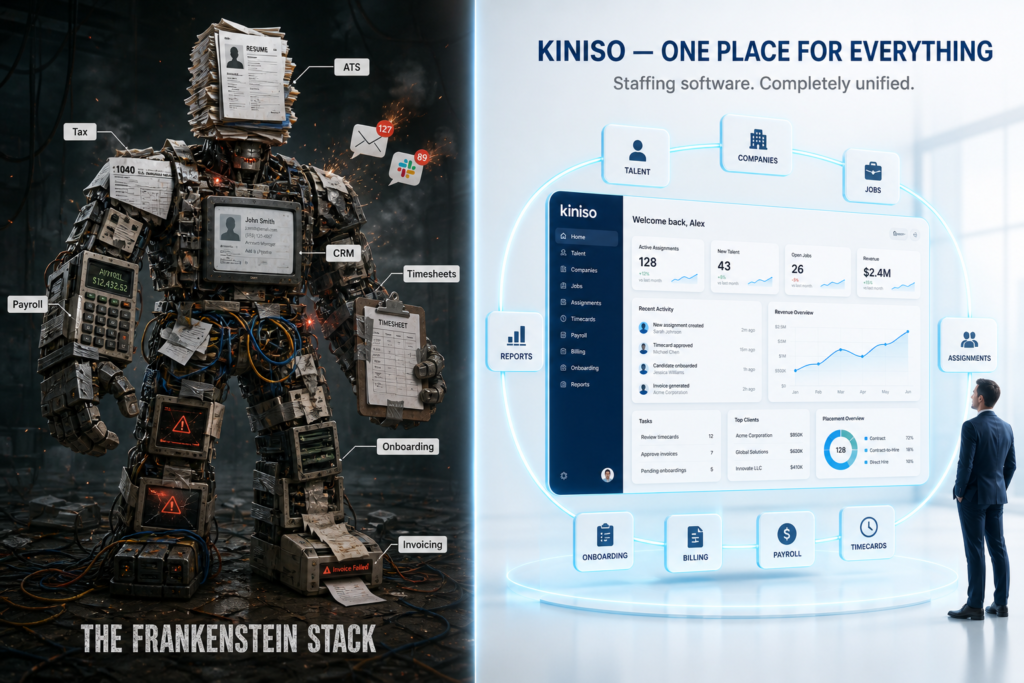
That distinction — between integrating two systems and building one workflow from the ground up — is the real story behind how these three platforms differ today, and it matters more to a staffing firm’s day-to-day operations than any individual feature comparison.
TempWorks vs. Avionté vs. KinISO at a Glance
| TempWorks | Avionté | KinISO | |
|---|---|---|---|
| Original foundation | Established staffing and back-office software | Established staffing and back-office software | Modern all-in-one staffing platform |
| Modern front office | Beyond, a browser-based ATS and CRM introduced in 2018 | BOLD, launched in 2019 after Avionté acquired COMPAS | Sales, CRM, recruiting and candidate management built into the platform |
| Back office | Enterprise handles core back-office functions | Avionté back-office technology handles payroll, billing and related functions | Payroll and administrative functions are part of the KinISO platform |
| How the front office evolved | Beyond was built using the TempWorks API and established Enterprise technology | Avionté combined the COMPAS front office with the Avionté back office | Front and back office were designed as parts of the same modern platform |
| API structure | TempWorks provides APIs for integrations | Avionté currently maintains separate Front Office and Back Office APIs | Built on modern cloud-native infrastructure |
| Architecture today | Some functions remain distinct between Beyond and Enterprise | BOLD data can synchronize with Classic Back Office | Designed around one staffing workflow rather than connecting a new front end to an older back end |
| Basic philosophy | Modernize and extend an established staffing system | Combine and modernize proven front- and back-office systems | Build the staffing operating platform on modern cloud technology |
This table is not a ranking of which platform is “best.” It is a comparison of how three staffing software companies arrived at where they are today, and the paths they took explain a lot about how each system behaves once it’s actually running inside a staffing firm.
The Avionté BOLD Story Explains the Difference
Avionté is probably the clearest example of this pattern. The company had already built a successful staffing back-office platform when it acquired COMPAS Technology in 2018, a firm that had developed a modern, web-based front-office recruiting platform. Avionté has described its strategy plainly: combine the front-office technology of COMPAS with the back-office capabilities Avionté already had. A year after the acquisition, Avionté launched AviontéBOLD.
Whether BOLD is simply COMPAS with a new name is a fair question, and the honest answer is not exactly, but the lineage still matters. The modern BOLD front office grew out of COMPAS, while the back office grew out of Avionté’s existing technology, and that distinction is still visible in the platform’s architecture today. Avionté’s own developer documentation states that the company currently maintains separate APIs for its front-office and back-office systems. Avionté continues to improve the synchronization between the two; its April 2026 release notes, for example, describe BOLD information automatically synchronizing to Classic Back Office and making back-office fields accessible to recruiters directly inside BOLD.
That is genuinely useful functionality, and it should make daily work easier for the people using it. But it also illustrates the underlying architectural point: two systems can work together extremely well and still be two different systems underneath the surface.
TempWorks Took a Similar Path
TempWorks has a different history but faced essentially the same challenge. Its Enterprise platform had already been running staffing operations for years by the time the market began expecting browser-based recruiting and CRM technology as standard. In 2018, TempWorks introduced Beyond, describing it as a browser-based ATS and CRM built on the TempWorks API, and it explained that Beyond relied on Enterprise’s established technology to handle back-office functionality.
That approach is not necessarily a weakness. Nobody replaces payroll infrastructure that reliably processes thousands of checks each week simply because a competitor built a more polished CRM. The sensible path is to modernize around the systems that already work, and that is what TempWorks did. But that approach can also create some unusual seams. TempWorks documentation notes, for instance, that tasks created in Beyond are entirely separate from tasks created in Enterprise, and that invoice setup can be handled inside Beyond while the invoices themselves are still processed and emailed through Enterprise. Everything may be connected, in other words, without everything being the same application.
KinISO Started From the Other Direction
KinISO had an advantage that neither TempWorks nor Avionté had when their original systems were first designed: it got to start later. KinISO describes its current technology as cloud-native, with development of the modern platform beginning around 2017 using containerization and Kubernetes. Rather than starting with payroll and layering a CRM on top years later, KinISO was designed around the broader workflow of a staffing company from the outset, covering sales and prospect management, client management, recruiting, candidate tracking, assignments, administrative functions, payroll, and client and employee interaction in a single system.
That starting point changes the fundamental question a platform is built to answer. For TempWorks and Avionté, the practical question was how to connect a modern CRM to an established back office. For KinISO, the question was how information should move through a staffing company in the first place: a salesperson wins a client, the client creates jobs, recruiters work those jobs, candidates become employees, employees become assignments, assignments generate time, and time creates payroll and billing. Those steps are not separate business processes bolted together. In KinISO’s design, they are treated as one continuous staffing workflow.
Integration Isn’t the Same Thing as Architecture
This is probably the most important distinction in the whole comparison. Both TempWorks and Avionté support integrations, and it would be inaccurate to suggest otherwise. Avionté maintains extensive Front Office and Back Office APIs, and TempWorks provides API functionality along with support for third-party integrations. So the question worth asking isn’t whether these systems can integrate with other software.
The better question is how much integration your core staffing software requires just to operate the way you want your firm to run. Every staffing company will connect to outside technology at some point, whether that’s a job board, a background screening company, a VMS, an accounting platform, or a specialized sourcing tool, and that’s completely normal. The architectural difference shows up when your core staffing workflow itself depends on multiple applications, databases, or synchronization processes just to function day to day. The more layers involved, the more opportunities there are for duplicate data, delayed synchronization, conflicting versions of the same record, extra clicks, user confusion, ongoing integration maintenance, reporting problems, and the workarounds that inevitably follow. Modern software architecture doesn’t eliminate the need for integrations altogether; it changes what those integrations are actually needed for.
The Question Staffing Firms Should Ask
When comparing TempWorks, Avionté, KinISO or any other staffing platform, it’s worth setting aside “does it have this feature” in favor of a more useful question: was this feature built into the platform from the start, or was it connected to it later? Both approaches can work well, and each comes with real advantages. Mature platforms have processed millions of transactions, encountered thousands of unusual staffing scenarios, and accumulated years of hard-won industry knowledge that newer systems simply haven’t had time to build up. Newer cloud-native platforms have a different kind of advantage: they get to build using technologies and workflows that didn’t exist when the older systems were originally designed.
For staffing firms evaluating their next system, understanding that underlying difference is likely to be more useful than working through another checklist of features.
Key Points
- TempWorks and Avionté are established staffing platforms whose back-office capabilities were developed long before today’s expectations around browser-based CRM, mobile technology and cloud applications.
- Avionté BOLD has roots in COMPAS. Avionté acquired COMPAS in 2018 and used its front-office technology as part of the platform that became AviontéBOLD.
- TempWorks Beyond was added later than Enterprise. TempWorks launched the browser-based Beyond ATS/CRM in 2018, built on its API and existing Enterprise technology.
- Integration doesn’t necessarily mean one architecture. Avionté currently documents separate APIs for front and back office, while TempWorks documentation shows examples of functionality that remains distinct between Beyond and Enterprise.
- KinISO started with modern cloud architecture, designing its platform around the entire staffing workflow from the beginning rather than modernizing a system originally built decades earlier.
Frequently Asked Questions
What is the difference between TempWorks, Avionté and KinISO? All three are software platforms built for staffing companies. TempWorks and Avionté have much longer histories and developed substantial back-office capabilities around payroll, billing, assignments and staffing administration. KinISO is a newer platform built on modern cloud infrastructure, designed to combine sales, recruiting, candidate management, payroll and administrative functions from the start.
Is Avionté BOLD actually COMPAS? Not exactly. Avionté acquired COMPAS Technology in 2018 and combined COMPAS’s modern front-office technology with Avionté’s existing back-office technology, launching the resulting platform as AviontéBOLD in 2019. BOLD isn’t simply renamed COMPAS, but COMPAS is a significant part of its front-office history.
Does Avionté have separate front-office and back-office systems? Avionté’s current developer documentation states that it maintains separate Front Office and Back Office APIs. The company has continued adding functionality that synchronizes information between BOLD and Classic Back Office.
What is TempWorks Beyond? TempWorks Beyond is a browser-based ATS and CRM launched in 2018. TempWorks built it on the TempWorks API while relying on established Enterprise technology for back-office functions.
Can TempWorks and Avionté integrate with other software? Yes. Both platforms provide integration capabilities. The distinction in this comparison isn’t whether integrations are possible — it’s whether core functions live inside the same underlying application architecture or need to communicate across different parts of the technology stack.
Is KinISO cloud-based staffing software? Yes. KinISO was designed using cloud-native infrastructure and describes itself as an all-in-one staffing platform covering sales, recruiting, candidate management, payroll and administrative functions.
What is cloud-native staffing software? Cloud-native staffing software is built from the beginning to run on modern cloud infrastructure, rather than being adapted from software originally designed for local servers or desktop environments. Being accessible through a web browser does not, on its own, make software cloud-native.
What is front-office staffing software? Front-office staffing software generally covers the work performed by recruiters and salespeople: CRM, applicant tracking, candidate management, job orders, recruiting, sales activity and client communication.
What is back-office staffing software? Back-office staffing software handles the operational and financial work that follows a placement: assignments, timekeeping, payroll, billing, taxes, employee administration and compliance. The more important question for staffing firms today isn’t whether a system has both — it’s how tightly the front office and back office were designed to work together.