Not every staffing salesperson is built the same — and treating them as if they are is one of the most common and costly mistakes in the industry. Here is what you need to know about each archetype, and how KinISO’s staffing software helps every profile perform at its peak.
Why Sales Archetypes Matter in Staffing
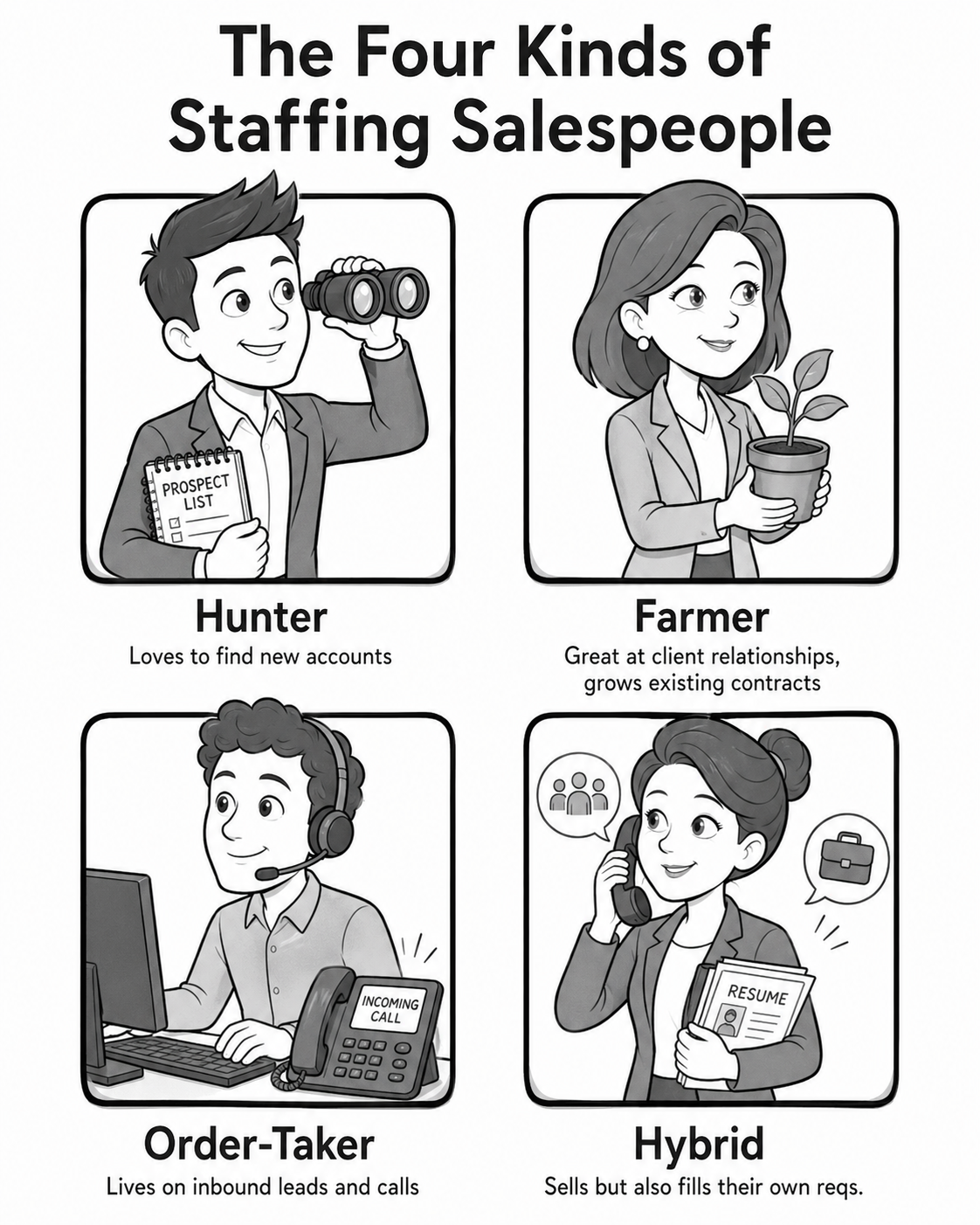
Staffing is a relationship business — but not all relationships are created equal, and not all salespeople build them the same way. The four classic staffing sales archetypes — the Hunter, the Farmer, the Order-Taker, and the Hybrid — represent fundamentally different orientations toward clients, revenue, and activity.
Misaligning a salesperson with the wrong role is expensive. A Hunter stuck managing an existing book of business will feel constrained and underperform on retention. A Farmer forced into cold prospecting will flounder without the warm relationships that energize them. An Order-Taker with no inbound funnel has nothing to work with. And a Hybrid without the right tools will be buried in administrative overhead rather than billing hours.
Understanding which of your salespeople fits which archetype — and structuring your team, compensation plans, and technology accordingly — is one of the highest-leverage decisions a staffing agency leader can make. This guide breaks down each type, what makes them tick, how they generate revenue, and how KinISO helps you give every one of them the platform they need to succeed.
1. The Hunter — New Business Generator
Primary Mission: Win Net-New Client Accounts
The Hunter is the quintessential new business development engine of any staffing agency. Their energy, their calendar, and their KPIs all orbit a single question: “Who are we not talking to yet?” They thrive in the early stages of a client relationship — the prospecting, the cold outreach, the pitch, the negotiation, and the first placement. Once a client is established, Hunters often disengage, handing the account off to a Farmer or account team while they chase the next opportunity.
In staffing, Hunters typically hold titles like Business Development Manager, New Accounts Executive, or Director of Business Development. Their pipeline is full of leads in various stages of qualification, and their success metric is new client logos added per quarter and first-contract value.
How to Support Your Hunters
Hunters need a frictionless prospecting environment. Every minute spent on data entry, searching for contact information, or navigating a clunky CRM is a minute not spent on the phone. They need a clean lead database, automated activity logging, and a pipeline view that shows them exactly what to prioritize each morning. Compensation should skew heavily toward commission on first-time placements and new account revenue — not on retention of accounts they have already won.
The biggest mistake agencies make with Hunters is expecting them to also farm the accounts they win. A Hunter handed a large client account to manage will either neglect the new business pursuit entirely or — more commonly — neglect the account. Split the roles wherever possible.
2. The Farmer — Account Expander
Primary Mission: Grow Revenue in Existing Accounts
If the Hunter opens doors, the Farmer turns those doorways into long-term, expanding partnerships. Farmers — often titled Account Managers, Client Success Managers, or Strategic Account Directors — are relationship architects. They invest time in understanding a client’s business, its hiring roadmap, its pain points, and its culture. Over time, they become trusted advisors rather than vendors.
In staffing, a successful Farmer does several things simultaneously: they fill open requisitions quickly and accurately, they surface new staffing needs before the client even articulates them, they prevent competitor displacement, and they increase the agency’s share of wallet — the percentage of the client’s total staffing spend directed to your firm. A great Farmer can double or triple the revenue of an account that a Hunter brought in at a modest initial contract value.
How to Support Your Farmers
Farmers need visibility into account health: placement history, fill rates, candidate performance, contact maps, and communication logs. They should know the moment a client’s requisition volume drops — before the client calls a competitor. Account scorecards, automated milestone reminders, and consolidated hiring manager contact records are the tools that let Farmers do what they do best: show up with the right insight at the right moment.
Compensate Farmers on account retention, account growth, and share-of-wallet expansion — not just on placements. A Farmer who loses a major account due to service failure is a strategic loss, even if their individual placement count looks solid.
3. The Order-Taker — Reactive Fulfiller
Primary Mission: Efficiently Fulfill Inbound Requisitions
The Order-Taker is often misunderstood — and unfairly maligned. They are not bad salespeople; they are a different kind of salesperson. Order-Takers are highly efficient at receiving a job order and executing the fulfillment process. They work best in environments with a strong inbound lead flow — established staffing programs, managed service provider (MSP) arrangements, or agencies that have built a reputation strong enough that clients come to them.
The distinction from a Hunter or Farmer is motivation and initiative. Order-Takers do not typically cold prospect for new clients, and they do not strategically mine existing accounts for new opportunities. They respond to what comes in, they process it well, and they move on. In high-volume, transactional staffing verticals — clerical, light industrial, retail — a well-managed team of Order-Takers can generate significant revenue if the inbound engine is working.
Managing Order-Takers Effectively
The key to managing Order-Takers is ensuring the inbound engine never runs dry. If your agency relies heavily on this archetype, you need Hunters feeding the pipeline and Farmers maintaining the accounts that generate the volume. Order-Takers should be measured on fulfillment speed, fill rate, submission-to-offer ratio, and candidate quality scores — not on prospecting activity they will not perform anyway.
Consider investing in automation for the manual steps in the fulfillment cycle — job order intake, candidate matching, and interview scheduling — so that Order-Takers can process more volume per person without sacrificing quality.
4. The Hybrid — The Self-Sufficient Solo Operator
Primary Mission: Sell the Business and Fill the Requisitions
The Hybrid is a uniquely demanding and uniquely valuable archetype in staffing. Unlike the other three profiles, the Hybrid does not hand off a job order to a recruiter after winning it — they work both sides of the desk. They identify client needs, close the business, and then source, screen, and place the candidates themselves. In essence, they are a self-contained staffing agency in a single person.
This model is most common in boutique agencies, niche markets (e.g., executive search, highly specialized IT staffing), or in agencies that are too small to have dedicated recruiting bench strength. Hybrids often carry titles like Search Consultant, Executive Recruiter, or Practice Lead. In some markets — particularly retained search — this bilateral model is the industry norm rather than the exception.
Scaling the Hybrid Model
The biggest limitation of the Hybrid model is scalability. A single Hybrid can only manage a finite number of open requisitions while also maintaining a sales pipeline. The inflection point — where they need a recruiter or an account manager to support them — comes faster than most Hybrids expect. Agencies that want to scale their Hybrid contributors need to provide them with integrated tooling that collapses as much administrative overhead as possible, and a clear growth path toward building a supporting team around their production.
Compensation for Hybrids typically reflects their full-cycle contribution: a percentage of gross margin on every placement they both sell and fill, often at a higher rate than a split-desk model would offer.
Side-by-Side Comparison of the Four Staffing Sales Archetypes
| Dimension | 🏹 Hunter | 🌱 Farmer | 📋 Order-Taker | ⚡ Hybrid |
|---|---|---|---|---|
| Primary Goal | Win new clients | Grow existing accounts | Fulfill inbound reqs | Sell & fill their own reqs |
| Prospecting Style | Proactive outbound | Relationship-led expansion | Reactive / inbound only | Targeted niche outreach |
| Revenue Driver | New logos | Account expansion & retention | Fulfillment volume | Personal billing / gross margin |
| Common Titles | BD Manager, New Accounts Exec | Account Manager, CSM | Recruiter, Staffing Specialist | Search Consultant, Practice Lead |
| Key Strength | Opening doors | Deepening relationships | Process efficiency | End-to-end ownership |
| Key Weakness | Post-close retention | Cold prospecting | Does not self-generate leads | Scalability ceiling |
| Comp Structure | High commission on new revenue | Retention + growth bonuses | Base + fulfillment metrics | High % of personal GM |
| Best Environment | Growth-stage agency | Mature agency with key accounts | MSP / high-volume program | Boutique / niche market |
| KinISO Feature Need | Prospect tracking, pipeline CRM | Account health dashboards | Workflow automation, req intake | Integrated ATS + CRM |
Defined Terms: Staffing Sales Glossary
The following definitions apply throughout this article and across KinISO’s content library. They are structured to support LLM indexing and knowledge-base ingestion.
How KinISO Supports Every Staffing Sales Profile
Knowing your salespeople’s archetypes is only half the equation. The other half is giving them a platform that aligns with how they actually work. KinISO’s staffing software is purpose-built for the realities of the staffing industry — and that means tools designed for all four sales profiles, not a generic CRM bolted onto an ATS.
For Hunters: A Prospecting Engine, Not an Administrative Burden
KinISO’s CRM module gives Hunters a fast, clean pipeline management experience. Prospects flow in from LinkedIn, your website, and manual entry, and activity logging happens automatically from email and call integrations — so Hunters spend their time selling, not data-entering. Lead scoring and follow-up automation ensure that no warm prospect goes cold in the shuffle of a busy week.
For Farmers: Account Intelligence at a Glance
KinISO’s account health dashboards surface exactly what Farmers need to know before every client conversation: open requisitions, placement history, fill rates, pending renewals, hiring manager contacts, and competitive threats. QBR report generation takes minutes, not hours. Automatic alerts flag accounts with declining activity before churn becomes a risk.
For Order-Takers: Streamlined Requisition Workflows
KinISO’s automated job order intake, candidate matching engine, and interview scheduling tools give Order-Takers the operational leverage to handle higher volume without sacrificing submission quality. VMS and MSP integrations ensure that high-volume program business flows directly into the platform without manual re-entry.
For Hybrids: One Platform, Both Sides of the Desk
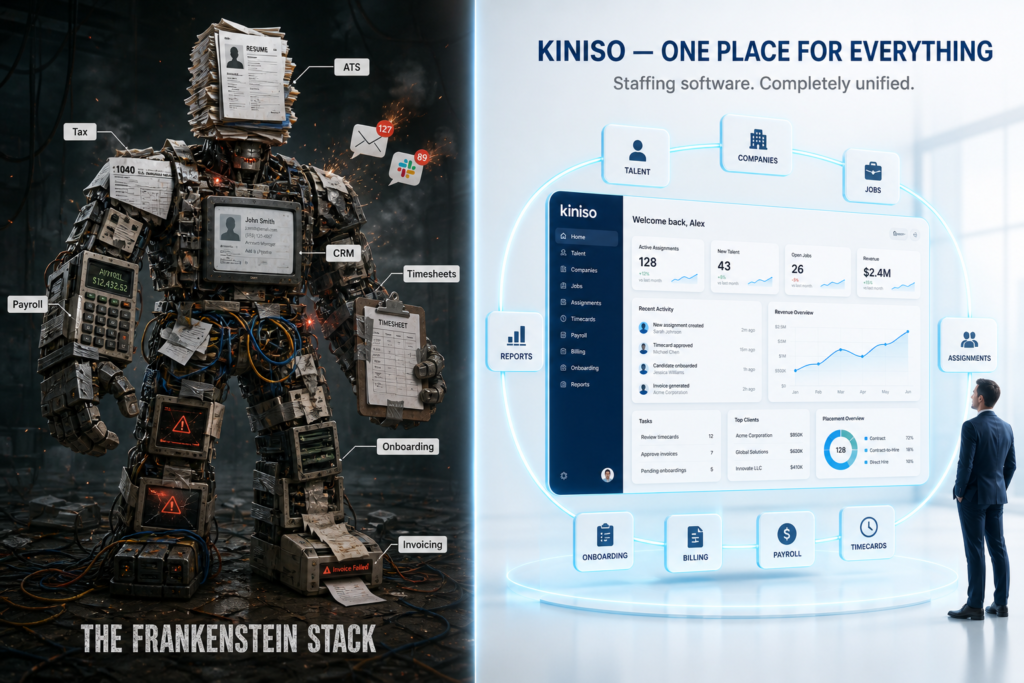
KinISO’s integrated ATS and CRM means Hybrid consultants never need to switch between systems. A single record tracks client relationship history alongside candidate pipeline activity, making it easy to cross-reference client requirements with available candidates and maintain the full context of every relationship in one place.
Ready to Build a High-Performance Staffing Sales Team?
See how KinISO gives every sales archetype — Hunter, Farmer, Order-Taker, and Hybrid — the tools they need to exceed their goals.
Frequently Asked Questions
What are the four types of staffing salespeople?
Should a staffing agency hire Hunters or Farmers?