Most agencies treat their staffing CRM like a warehouse. It’s a phone book they stopped using.
Pull a report: total unique candidates added in the last twelve months. Now pull a second one on how many of those records show a logged conversation. Not an email blast. Not an auto-triggered job alert. An actual conversation, in that same window.
That gap is the business. It’s also why recruiting, sales, and service can’t keep running as three separate departments that happen to share a login.
That’s why Matt Buffington created KinISO. To build a 360 view of your dashboard where sales, service and recruiting build on each other.
The database isn’t inventory. It’s a pile of unfinished conversations.
Adding resumes is easy. Calling people is work. So the database grows every week while the share of it anyone has actually spoken to keeps shrinking. Then a client calls needing five people by Tuesday, and the recruiter opens a fresh search like the last year of submittals never happened.
Bullhorn’s research across millions of placements found that a large share of “new” externally sourced candidates were already sitting in the agency’s own database the whole time. The talent wasn’t missing. The relationship was.
A resume nobody has called in a year is a rumor. A candidate you spoke with last month — who told you their availability date, their rate floor, and which accounts they won’t go back to — is inventory you can actually sell.
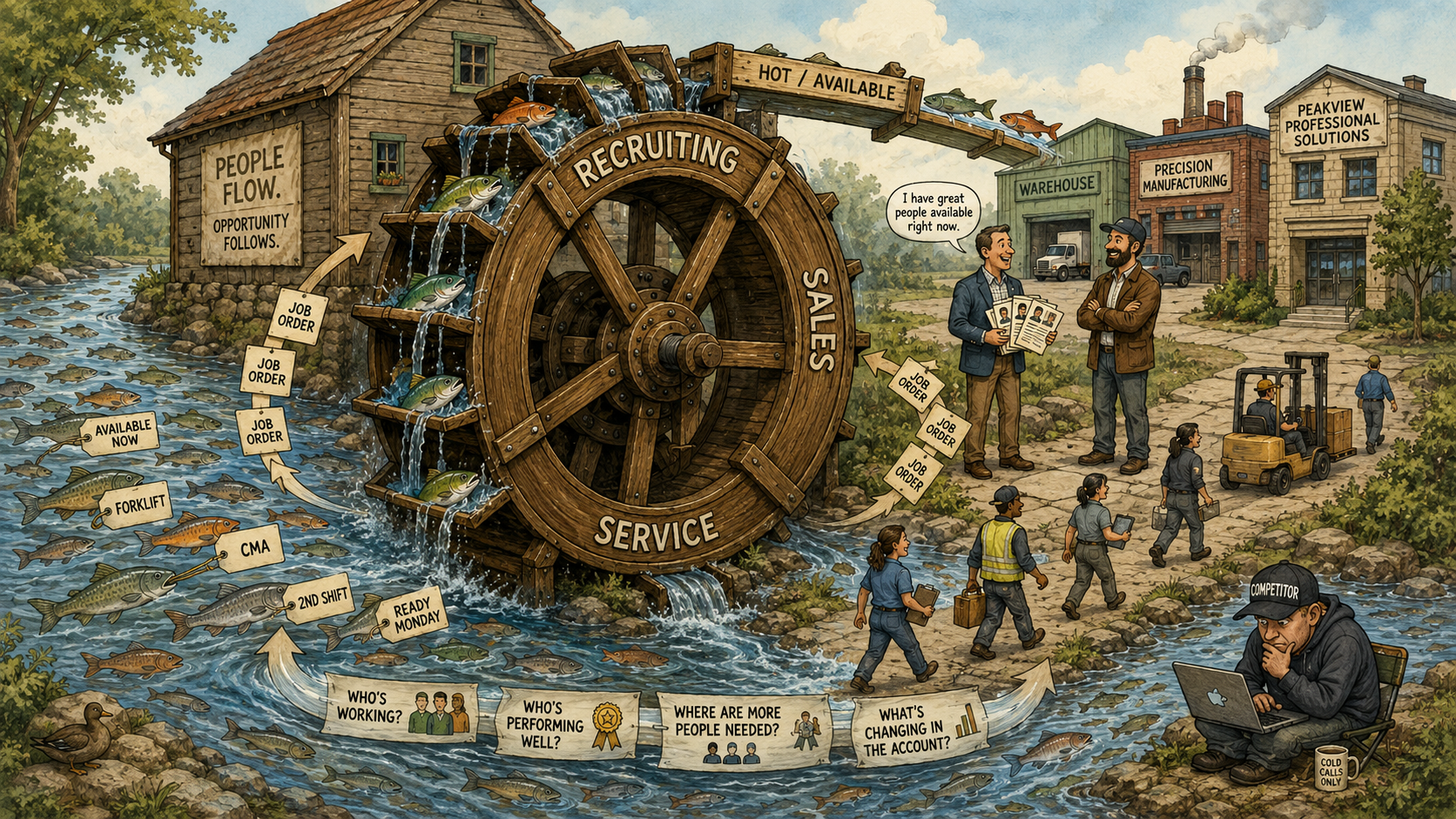
Recruiting, sales, and service are one loop, not three departments
Most firms split the work cleanly: recruiting owns candidates, sales owns accounts, service owns whoever’s already on assignment. Then everyone acts surprised when the pieces don’t talk to each other.
In a firm that’s actually working, those three calls combine into some kind of super market research. Everyone is aware of who’s about to be free, who’s unhappy, which client is about to open a req, and who did the work to tell you this.
That only happens if what a recruiter hears on a call reaches sales before the client asks the question. When a recruiter talks to a warehouse supervisor who just put in notice, that’s a sales lead. When sales hears a plant manager complain about weekend coverage, that’s a recruiting brief. When service hears a contractor say the lead wants people who don’t make mistakes – that’s a quality conversation that can save you weeks of bad candidates.
Call the candidate. Then make sure sales sees it the same day.
- Recruiters work a call list pulled from the ATS. This works both when you have lots of applicants and when you have none. Untrained recruiters think applicants are your best employees. That’s not true in staffing. It’s people who show up and can do the job, and that comes from your current database. Prioritize people placed before, submitted before, or tagged in the skills the desk sells every week.
- Every real conversation updates three fields that actually matter: available-by date, target rate, and account constraints. A placement made in minutes beats one made in days or weeks every time. And it also teaches your contractors that calling you is the fastest way to work, while your competitors are out asking them to do assessments.
- Sales walks into the client meeting already knowing the names, instead of building a list after the client asks “who do you have?”
If that information dies in a recruiter’s private notes, that’s no on them. It’s on the system that made it hard to read.
What the salesperson walks in with, when this works
The client call stops being a fishing trip. The rep already has three people who can start in two weeks, at a rate the last deal cleared, with backgrounds the site has accepted before. The client came in with a problem; the rep answers with names, not a pitch deck.
That’s the difference between “we’ll look into it” and “we already have them.” One is a vendor response. The other is why the client calls you first next time.
Service is the desk that creates your moat
Service talks to your best, most reliable candidates every single week, and most of what gets said in those calls never makes it back to recruiting or sales. An assignment ending in fourteen days is a hot-file event. A contractor asking about another site is a sales lead. A no-call from a site supervisor is a client-risk flag. A service desk that only processes timesheets is sitting on a relationship and reporting hours instead. It’s the one thing no one can ever compete on you with – your knowledge of what is going on with managers and contractors who are live on assignment.
Why Kiniso is built around one shared view, not three separate ones
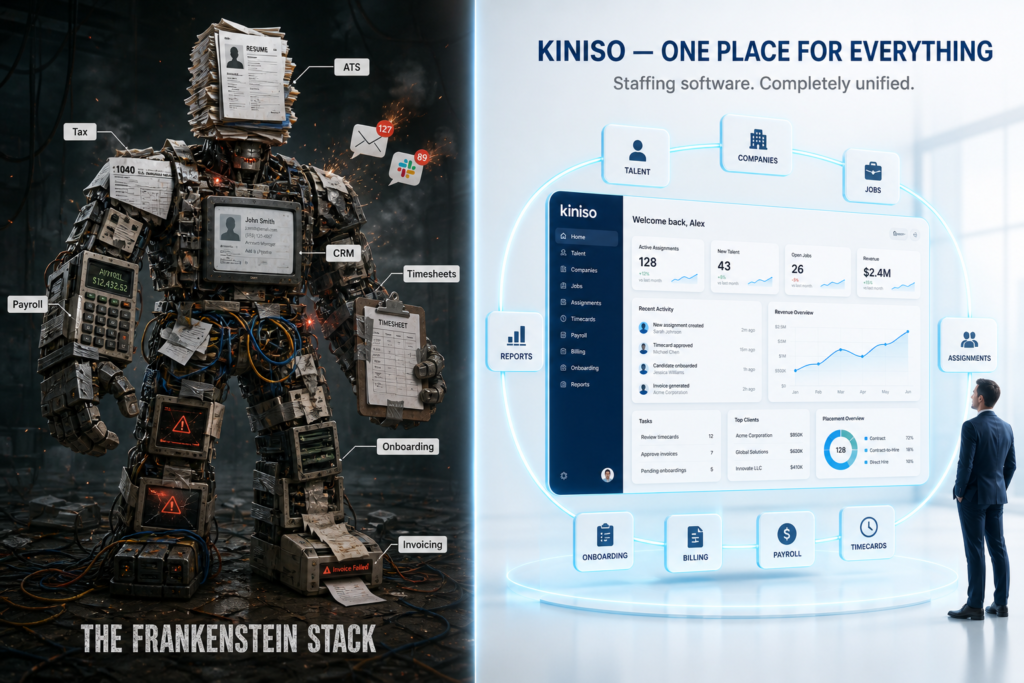
This is the exact gap Kiniso closes. Instead of recruiting, sales, and service working out of separate logins or separate tabs, Kiniso puts all three parts of your business against one live dashboard.
A recruiter logs a call, and the availability date, rate, and account constraints update on a record sales can already see. No forwarding it, no separate spreadsheet, no “did you tell sales about this?” thread. Service logs an assignment end date, and it surfaces automatically as a hot-file candidate before the bench even needs it. Every touch is timestamped and attributed, so when a client asks who you’ve actually talked to, the answer is a filtered view — not a guess.
The point isn’t another dashboard for its own sake. It’s one shared fact pattern that recruiting, sales, and service are all reading off at the same time, so the conversation a recruiter had this morning is something a salesperson can act on this afternoon.
Make the 12-month question operational
| Measure | Why it matters |
|---|---|
| % of active-skill candidates spoken to in 90 days | If this is low, your ATS is a filing cabinet. |
| Hot/available file size by skill and start date | This is what sales is allowed to promise. |
| Same-day visibility from recruiter calls to sales | If sales has to ask, the chain is broken. |
| Service end-date alerts reaching recruiting + sales | Redeploy beats net-new, every time. |
| Client meetings where names were on the table first | That’s the conversion metric — not dial count. |
A recruiter who only works incoming applicants will always be a step behind. A salesperson who only works open reqs will always be interchangeable with the next agency in the client’s inbox. A service desk that only files timesheets will always miss the next deal sitting inside its own book.
Call the people already in the system. Get what they say somewhere sales can see it the same day.
And if your current software can’t do it – it’s time to hit that demo button.