Your AI Candidate Summary Sounds Like Proof. It Isn’t.
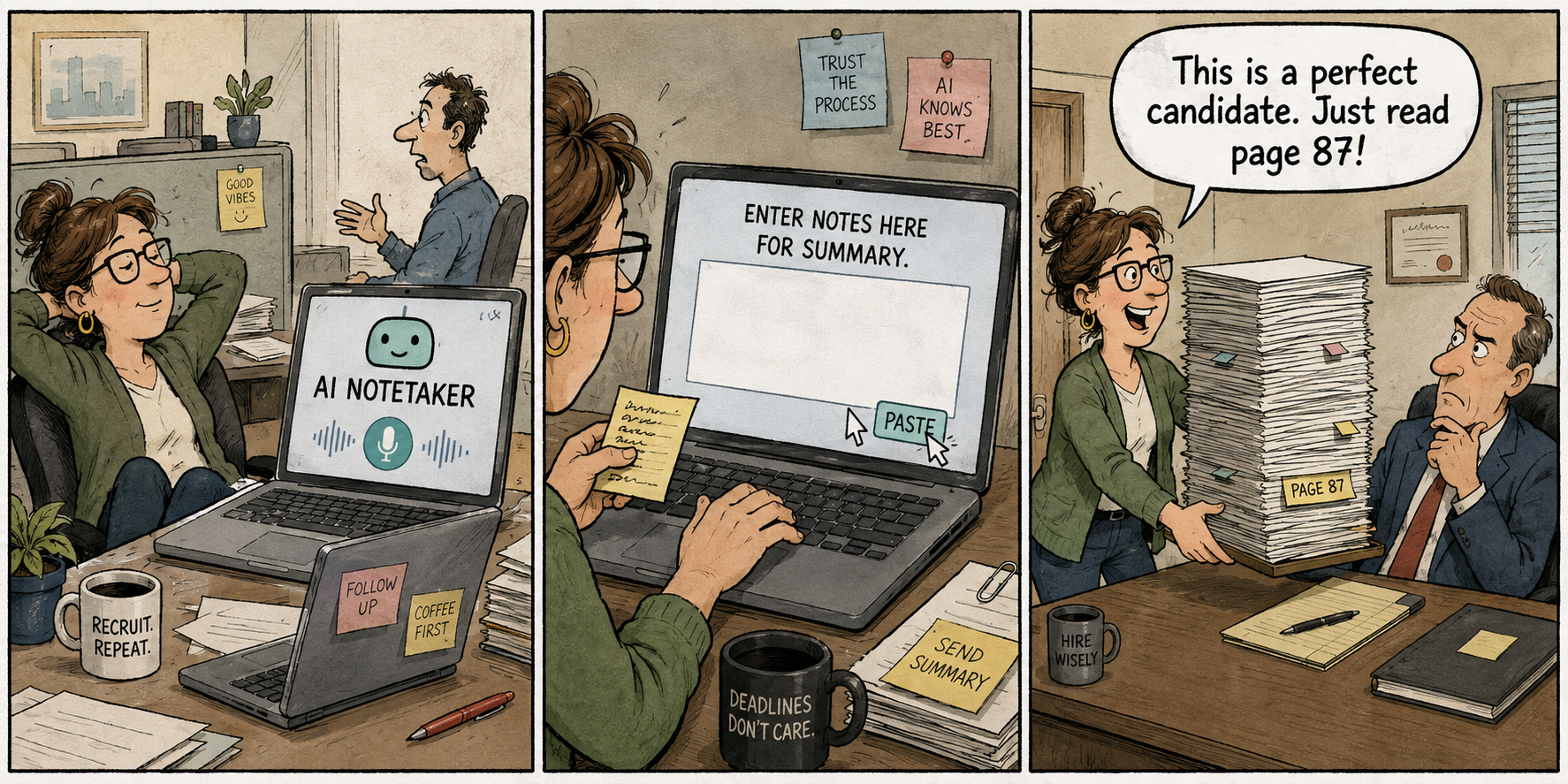
A recruiter gets off a phone screen. She pastes the resume and her notes into a chat window and asks for a candidate summary.
What comes back is neat, smooth, and sure of itself. It has a recommendation. It has supporting details. It is a lot better written than the four bullets she would have typed instead.
Her manager reads it and sees progress. Faster. Cleaner. More consistent across the whole team. Everybody agrees the tool worked.
The tool did work. It gave them exactly what they asked for: a smooth summary.
But nobody wanted smooth. They wanted a real read on the person. A smooth summary isn’t one. It’s a sales pitch in a suit, and the suit is good enough that most people never look under it.
The main problem: mixing up who said what
Three kinds of information go into a candidate write-up. They are not worth the same.
There’s what the resume claims. There’s what the candidate said in the interview. And there’s what the recruiter actually saw during the call.
A resume that calls someone hard-working and organized is not proof they are. It’s proof they wrote a resume. A candidate who tells a great story about a tough day has proven she can tell a great story about a tough day. That’s worth something. It is not the same as proving she does the job well.
Now feed all three into a model and ask for a summary. It will blend them. It won’t keep them apart, because nobody asked it to.
So the resume’s bragging and the candidate’s own stories come back out in the recruiter’s voice, as conclusions. Detail-oriented. Great with patients. Coachable. Flexible.
Nothing was checked. The claims just got moved into a stronger spot in the sentence. That’s the whole trick. Once you see it, you can’t stop seeing it.
The sales writing gives itself away
Read enough of these and you start seeing the same moves.
Adjective pileups. Four or five nice words in one sentence, none of them tied to anything specific. Quantity standing in for proof.
The obvious-truth bridge. A weak claim gets stapled to something everybody already agrees with. Which matters in a fast-paced office. Which is important on a busy desk. Nobody argues with the second half, so the first half sounds solid too. It isn’t. Yes, being professional matters. That doesn’t tell you this person is professional when things get bad.
Details standing in for facts. She gave specific examples instead of vague answers. Specific answers are easier to believe. That doesn’t make them true. A detailed story is still just a story the candidate told about herself. Details can be practiced, half-remembered, or handed to her by an interviewer asking leading questions.
Closing words. Strong candidate. Solid experience. Big plus. Encouraging. No red flags. These tell you how to feel instead of telling you what happened. “No red flags” is the emptiest one. It sounds reassuring without saying what was actually checked.
Saying it louder each time. The conclusion shows up early, then comes back stronger. Looks like a decent fit. Strong candidate. Good fit for the role. No concerns. That’s repetition doing the job that proof should be doing.
It sounds more sure than it has any right to be
The conclusions aren’t always wrong. The problem is that the writing sounds far more certain than the facts allow, and you can’t tell from reading it.
Models flatten things that actually matter. Two certifications with similar names from two different organizations get treated as the same thing, even when the client will take one and reject the other. A skill from a job five years ago gets mixed in with this year’s duties, so you lose track of what’s current. Software the candidate never named gets hinted at anyway.
Worse, the model fixes problems instead of flagging them. Job dates that run backward. Two jobs at the same time. A job that ended fast with no explanation. A summarizer’s job is to tell a clean story, so it tells one. Those problems don’t show up as open questions. They just vanish.
And the same document that quietly dropped an impossible date will turn around and call the candidate detail-oriented.
Then it ends by naming one or two things left to confirm. That makes it feel finished. Everything not on that short list reads as handled.
The format builds in bias
A nice conversation makes for warm notes. The model takes that warmth and spreads it across skills that have nothing to do with it. Friendly becomes good with patients. Calm becomes handles conflict well. Asked good questions becomes easy to train.
Those are separate skills. Each one needs its own proof.
And once the model leans positive early, everything after that gets read to match. Took notes means coachable. Learned a new system means flexible. Told a story about catching a mistake means safety-minded. There’s no second opinion, because nobody asked for one.
The two sides also get framed differently. The good stuff shows up as findings. The concerns show up as paperwork. The main thing to keep in mind. Just needs to be confirmed. The document is selling while pretending to evaluate. If a person wrote it that way, you’d spot it right away.
The stuff that should never have been in there
Models are loyal to what you give them. If the recruiter’s notes say a gap was for childbirth, or explain a schedule by talking about daycare, or mention a health issue the candidate brought up, all of it goes straight into the summary the client reads.
It shouldn’t. Almost all of it boils down to a plain job fact. Available weekdays, daytime hours. Career break from this month to that month. You lose nothing useful by cutting it down.
What the long version adds is bias and risk. Pregnancy, caregiving, and health sit close to categories that employment law protects. Putting them in a client-facing write-up is hard to defend, because they don’t make the hiring decision any better.
And remember where it lands. A candidate summary in your ATS isn’t a sticky note. It’s a company record tied to a hiring decision. It gets saved. If there’s ever a complaint, a lawyer can ask to see it. The question won’t be whether the recruiter meant anything by it. The question will be why it got written down and sent to a client.
Why nobody catches this
Here’s the part that keeps it going.
The output beats the old way on every single thing a manager can see. It’s more organized than a rushed note. It’s the same quality across every recruiter. It looks more complete. It sounds more professional.
A manager comparing this month’s summaries to last year’s will decide the writing got better. He’s right.
But how good the document looks and how good the judgment is are two different things, and only one of them shows up in a review.
The problem isn’t a bad output that makes you suspicious. It’s a good output that stops you from being suspicious. Confidence is the cheapest thing these tools make. It’s also the one thing a reader has no way to price.
What to do instead
Keep the tool. Change what you ask it for.
Make it separate the sources. Every summary should keep four buckets apart: what the resume says, what the candidate said, what the recruiter saw on the call, and what nobody has checked yet. When they’re separate, a reader can weigh each one. When they’re blended, nobody can.
Make it name who’s talking. The candidate said. She described a time when. The resume lists. The recruiter noticed. This has not been checked. That’s not a writing style. That’s the difference between a record and an argument.
Make every recommendation conditional. Not “strong candidate.” Instead: “possible fit, once we confirm her certification is active and the client accepts it, straighten out the job dates, and check that her clinical skills are current.” Naming what’s missing is the actual assessment.
Don’t let it invent traits. The model can report what someone said. It cannot turn what someone said into a personality trait. If a judgment call belongs in the file, a human should write it and put their name on it.
Strip the protected stuff before it goes in. Cut it down to the job fact first. The model won’t do it for you.
Make it list the problems. Tell it plainly: list every date that doesn’t add up, every gap, every job change with no explanation. Do not smooth them over. This is the single biggest fix, because it flips the tool’s default behavior.
Used this way, the tool is genuinely good. Better than most people at keeping structure, catching what the notes missed, and staying consistent across a whole team.
What it can’t do is tell you how much to believe. That was always the recruiter’s job.
It’s worth noticing when a tool quietly offers to take that job off your hands. And how good the offer looks while it’s happening.