Temporary staffing recruiter training can look far more complicated from the outside than it feels once you start doing the work. There are systems to learn, compliance rules to understand, clients to manage, candidates to qualify, assignments to fill, payroll issues to solve, and a long list of exceptions that never make it into the training manual.
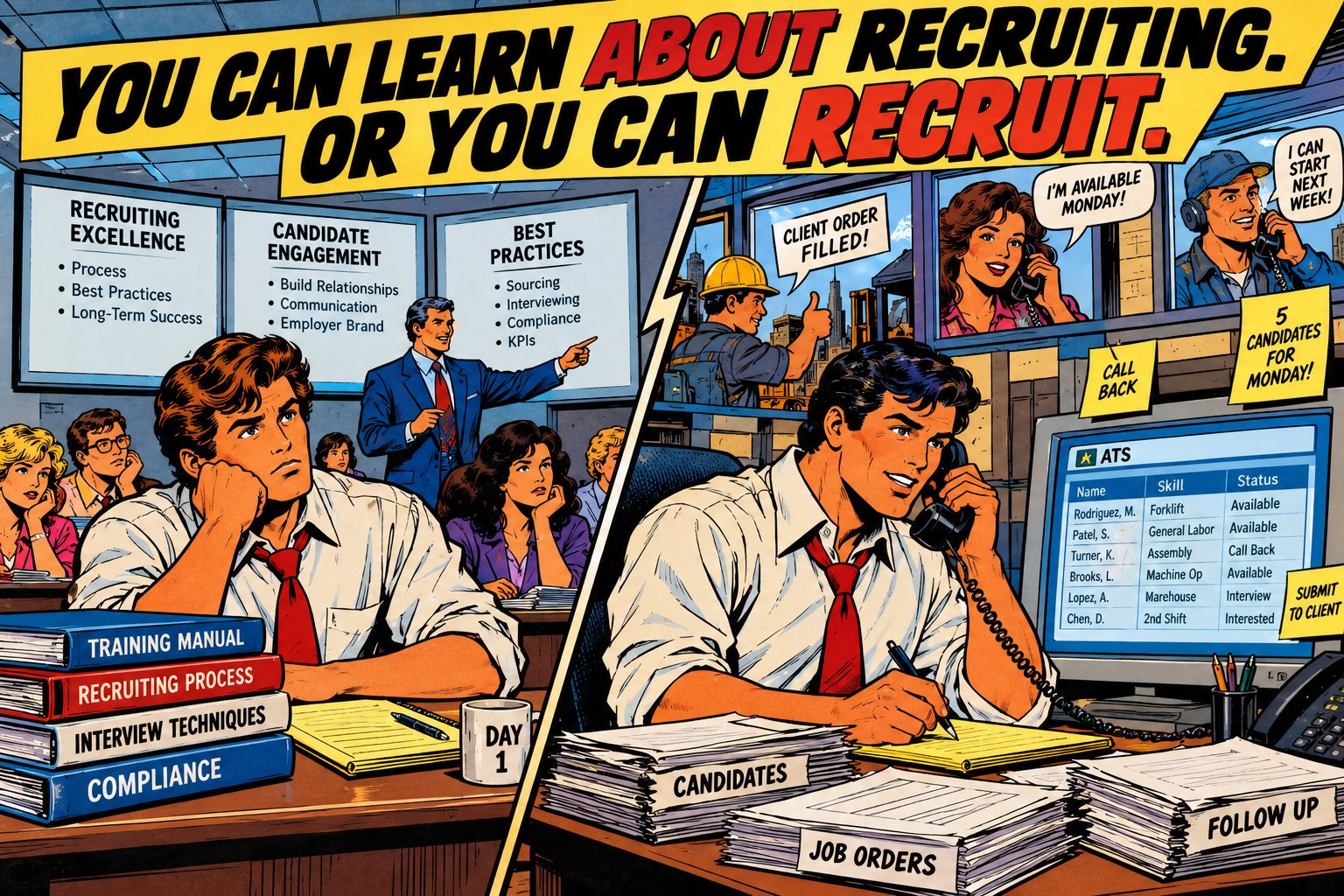
That complexity creates a natural temptation with a new hire, which is to train them on everything before letting them do anything. That is usually backwards. The most effective approach is to give a new recruiter real work from the start, such as calling candidates in the ATS and updating their status, and then teach the concepts as the questions come up.
Recruiters Need to Learn What the Job Actually Is
Years ago, one staffing company had two different ways new recruiters entered the business. Some began with formal training and spent days learning recruiting concepts, processes and techniques before touching the actual work. Others arrived at the branch and were handed a stack of resumes with a simple instruction: call these people, find out whether they are working, update their information, enter what you learn into the system, and call the next person.
The recruiters who started by doing the work tended to understand the job faster. They learned on day one that recruiting is not mainly about thinking about recruiting. It is about talking to people, asking questions, recording what you learned and following up, so you know who can work, when they can work and what kind of assignment makes sense for them. In temporary staffing, that distinction matters.
Why Hands-On Work Makes Recruiter Training Stick
None of this means training is unnecessary. Training is more useful once someone has enough experience to understand why the information matters. Take something like maintaining an available-candidate list. In a classroom, you can explain that candidates should be contacted regularly, availability should be updated, skills should be verified, notes should go into the ATS, and recruiters should know what kinds of assignments each candidate will accept.
All of that is true, but it lands differently once a recruiter has 25 candidates to call. Now they have questions of their own. What counts as available? What if the candidate doesn’t answer? How old can someone’s information get before we stop trusting it? What if they want first shift but would accept second? What should go in the notes, and what would actually help another recruiter fill an order tomorrow? Training stops being theoretical and starts solving problems the recruiter has already run into.
What Real Work Looks Like for a New Recruiter
A useful first assignment doesn’t need to be complicated, and complicated assignments can hide what you are trying to teach. Pick something real that a new recruiter can reasonably finish. That might be calling 25 candidates in the ATS to update their work status, building a list of ten people who could start this week, or going back through an older job order to see who might still be relevant. It could also be calling employees on assignment to ask how it is going, or taking an open order and finding five people in the database who might fit.
Then review the work together. The point is not to see whether the recruiter stumbles onto the perfect process. It is to see how they work: what they noticed, what they missed, where they got stuck, what they asked and what they assumed. The most telling question is often whether they came back with work, meaning notes, updated records and a short list of people, or just a feeling that they were busy.
Teach Recruiters to Ask Better Questions
Good recruiter training should leave enough room for someone to get stuck. That sounds backwards, but staffing recruiters spend their careers working with incomplete information. A client says they need someone “ASAP.” A candidate says they can start “whenever.” A manager says the last employee “wasn’t a fit.” A job order arrives missing half of what the recruiter needs. Recruiters can’t wait for perfect instructions, so they have to learn when to move forward and when to stop and ask.
New recruiters should know that asking for help is expected, but not all questions are equally useful. “What should I do?” gives the team nothing to work with. Compare it with this: “I called 12 people and most aren’t interested because the shift starts at 5:00 a.m. Three said they’d take it if it started at 6:00. Should we ask the client whether the start time is flexible?” The second version brings back information the staffing company can act on, and that is what recruiting looks like.
Train Recruiters to Feed Information Back Into the Business
For temporary staffing firms, this is where recruiter training pays off most. A recruiter isn’t only filling jobs. They spend all day collecting market intelligence. Candidates tell them what competitors are paying, and employees explain why people are leaving assignments. Applicants point out which schedules are hard to fill, former employees mention which companies are hiring, and candidates describe skills they have picked up since the firm last spoke with them.
That information should end up somewhere it can be used, whether by recruiting, sales or service. A recruiter who learns early to capture it in the staffing system is worth more than one who only works today’s applicant queue, because they are building organizational memory that outlasts any single placement.
Work the Existing Database, Not Just the Job Board
Putting new recruiters into the existing candidate database early has another benefit. It shows them that recruiting doesn’t begin when someone applies to today’s posting. Most established staffing firms already have thousands, tens of thousands or sometimes hundreds of thousands of people in their ATS. Some are working, some are looking, some have new skills or have moved, and some are waiting for the right shift, pay rate or location.
If recruiters are trained mainly around new applications, the firm can develop an expensive habit where every job order becomes a brand-new search. Teaching recruiters to work the database breaks that cycle. They stop asking who applied today and start asking who the firm already knows that could work today, which is a far more productive habit.
Technology Should Make Recruiters Better at the Work
Staffing technology can organize workflows, remind recruiters who needs follow-up, make candidate records easier to search, surface available workers and take over repetitive administrative tasks. What it shouldn’t do is remove recruiters from the activity that teaches them how the staffing business works. Talking to candidates, talking to employees, understanding client demand and recording what happened are the core of the job. The best staffing systems make those activities easier and make the information they generate more useful across the company.
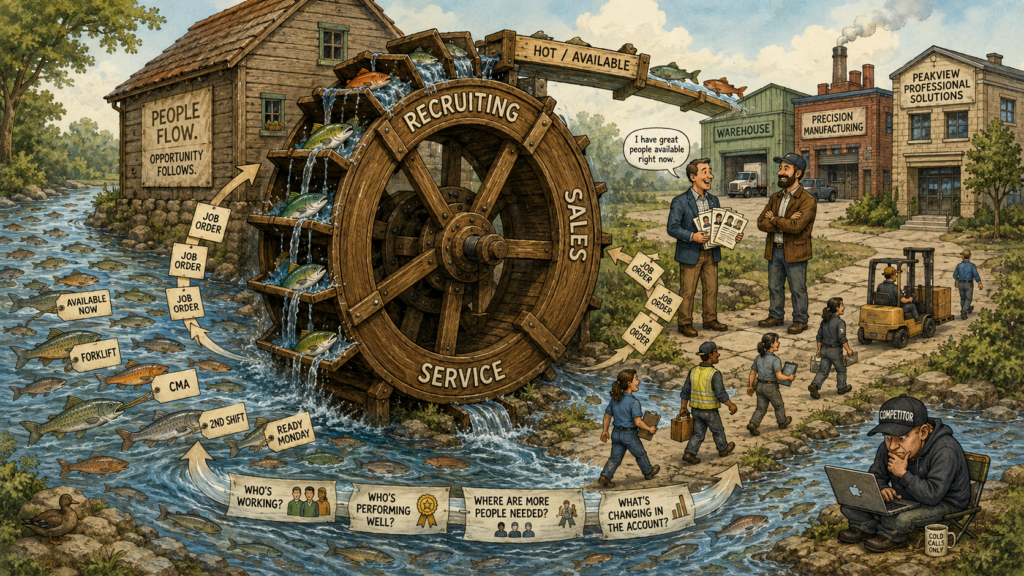
That matters because temporary staffing is ultimately a business built on information moving between people. Candidates tell recruiters what is happening, and recruiters tell sales and service. Clients tell sales what they need, and employees tell service how assignments are going. When that information is captured and shared, the whole firm gets smarter.
Temporary Staffing Recruiter Training Starts With the Work
New recruiters do need training. They need to understand compliance, interviewing, client expectations, documentation, employment law, technology and the specific processes of the firm they joined. But they also need experience. Give them meaningful work they can reasonably accomplish, let them run into real questions, teach them how to find answers, review what they did, and then teach the lesson.
Temporary staffing recruiters don’t become good by learning everything before they begin. They become good by doing the work, understanding what happened and getting a little better the next time.
Frequently Asked Questions About Temporary Staffing Recruiter Training
What should a new staffing recruiter do on their first day?
A new recruiter should start with a small, real task, such as calling 25 candidates in the ATS, confirming whether they are working and updating their records. This teaches the core loop of the job, which is talking to candidates, asking questions, recording what they say and following up, before any formal training on theory.
How long should temporary staffing recruiter training take?
There is no fixed length that fits every firm. A practical approach is to have new recruiters doing real work within the first days while formal training on compliance, client expectations and internal processes runs alongside. Training then answers questions the recruiter has already run into.
Should new recruiters learn compliance and employment law before working with candidates?
Yes, they need that training, and the goal is sequencing rather than skipping it. Early assignments like updating candidate availability are low-risk and teach the job, while compliance and employment law training builds alongside them so the recruiter understands why the rules matter.
Why should new recruiters work the existing ATS database instead of only new applicants?
Most established staffing firms already have a large pool of known candidates in their ATS. Working that database teaches recruiters to ask who the firm already knows that could work today, which avoids treating every job order as a brand-new search.
What makes a good first assignment for a new recruiter?
A good first assignment is concrete, reasonable to finish and reviewable. Examples include updating the work status of 25 candidates, building a list of ten people who could start this week, or finding five database candidates who might fit an open order. Review the results together to see how the recruiter works.