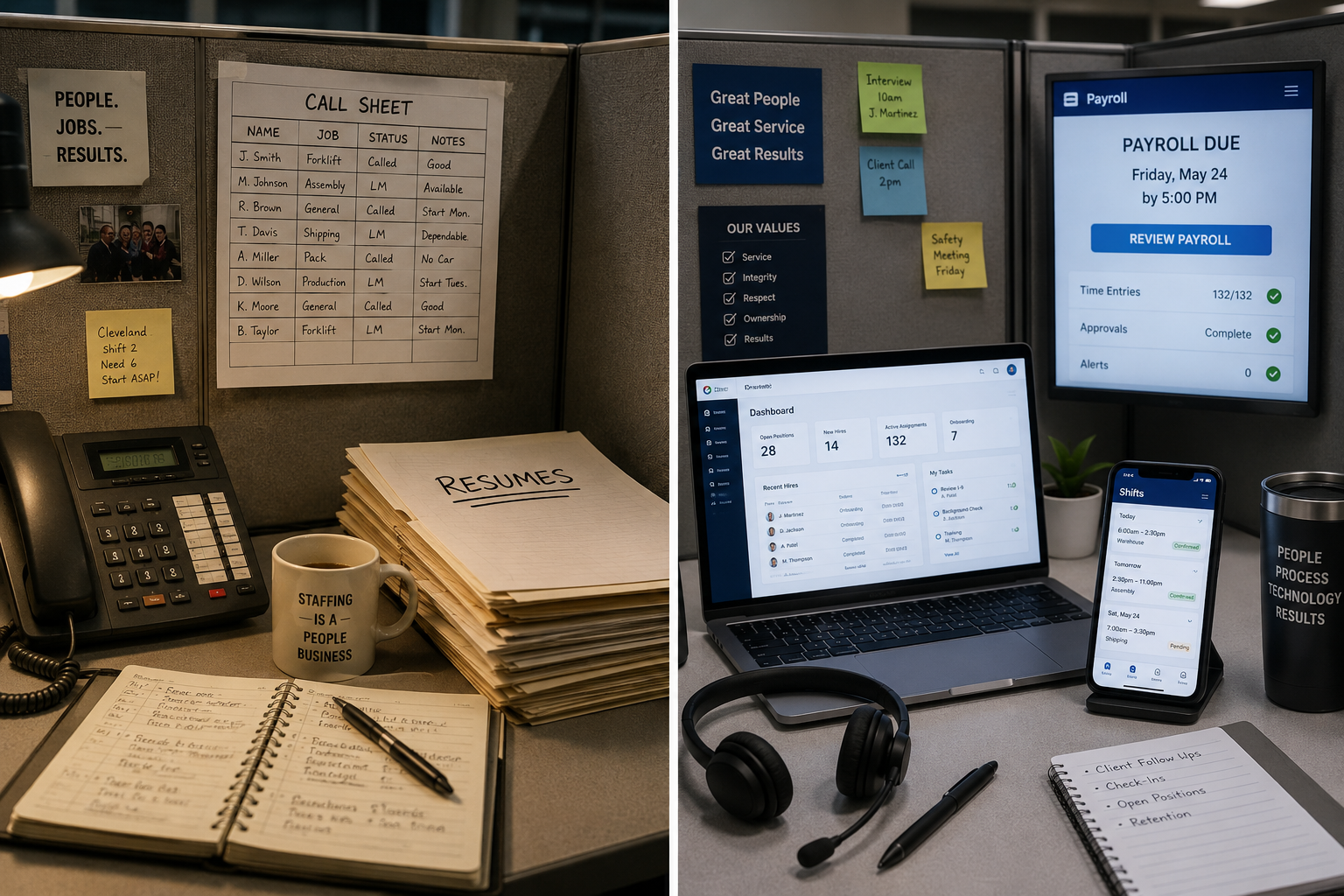
The early staffing recruiter had a simple job, at least on paper.
Find people who needed work. Figure out who was reliable. Match them with companies that needed help. Keep the client happy. Keep the worker showing up. Do it again tomorrow.
That version of staffing was built around local knowledge, relationships, urgency, and trust. The best recruiters knew who was available, who could pass a background check, who had transportation, who could handle the work, and which client manager was going to make life miserable for everyone involved.
It was selling and matching. But it was also judgment.
As the staffing industry grew, the size of the addressable market changed the business. Larger firms learned how to staff thousands, then tens of thousands of people. That required systems, automation, job feeds, payroll infrastructure, onboarding workflows, compliance tools, reporting, texting, scheduling, and candidate databases large enough to make the old Rolodex version of recruiting look quaint.
That growth changed the recruiter’s job. Some of the matching work moved into software. Some of the communication moved into automation. Some of the judgment got replaced by workflow.
But there was always a limit.
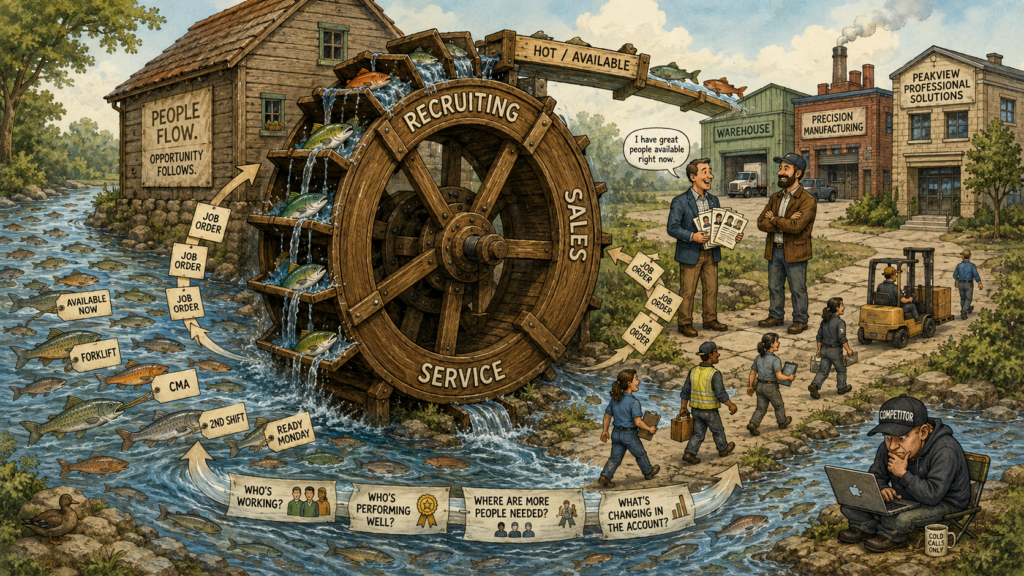
No staffing firm, no matter how large, could truly control even a local labor market. Staffing has always been structurally fragmented. Workers move. Clients churn. Pay changes. A competitor opens down the street. A warehouse changes shifts. A supervisor burns through people. A better opportunity shows up. A reliable worker suddenly has childcare problems, transportation problems, health problems, or simply decides the job is not worth it anymore.
The market was always moving underneath the recruiter.
That is even more true now.
We are no longer operating in a world where the biggest challenge is simply finding enough names. In many markets, the problem is that there are fewer available workers, an aging workforce, and more competition for the same people.
At the same time, jobs are easier to see than ever.
A worker can find openings on job boards, staffing apps, Facebook groups, Google, TikTok, text campaigns, referral links, and company career sites. Access is not the issue it once was. The worker does not need to wait for a recruiter to tell them where the jobs are.
But that does not mean the match is easier.
In some ways, it is harder.
The worker has more options, but less patience. The client has more data, but less tolerance for failure. The recruiter has more tools, but less time to use judgment. Everyone wants speed, but the actual problem is still human. Is this the right person, for the right job, at the right pay, at the right location, with the right expectations, at the exact moment they are willing and able to work?
That is a much harder problem than filling out a requisition.
This is why the staffing recruiter’s role is changing again.
Finding great people is no longer the finish line. It is the first step. The real advantage comes from what happens after the person says yes.
Can you onboard them quickly? Can you get their paperwork done without losing them? Can you make payroll simple? Can you communicate clearly? Can you solve the small problems before they become no-shows? Can you keep the worker connected long enough that they become part of your reliable core?
In some ways, this was always how staffing companies won.
Every good staffing office had its group of core people. The 50, 75, or 100 workers who would answer the phone. The people who trusted the office. The people who knew they would get paid correctly, treated fairly, and sent to clients who were not a complete disaster.
That core was never just a database segment. It was the business.
What has changed is the speed and the expectations around that relationship.
Taking care of people now includes things staffing firms did not have to think about as seriously before. Daily pay. Pay cards. Benefits. Faster onboarding. Mobile communication. Better assignment visibility. Transportation support in some markets. Cleaner handoffs between recruiting, service, payroll, and the client.
A worker who cannot get paid easily is not loyal. A worker who gets bad information is not loyal. A worker who is sent into a bad client environment without warning is not loyal. A worker who feels like every interaction with the staffing firm starts over from zero is not loyal.
And loyalty matters more when workers have more visibility, more options, and less reason to tolerate friction.
The recruiter is no longer just sitting between worker supply and client demand. The recruiter is sitting inside a two-sided marketplace where both sides can leave quickly, both sides have more information than before, and both sides expect better service.
The old recruiter could win by knowing who needed work.
The modern recruiter has to know who is worth calling, who is ready to move, what will make them say yes, what might make them disappear, which client can keep them, and whether the assignment is worth risking the relationship.