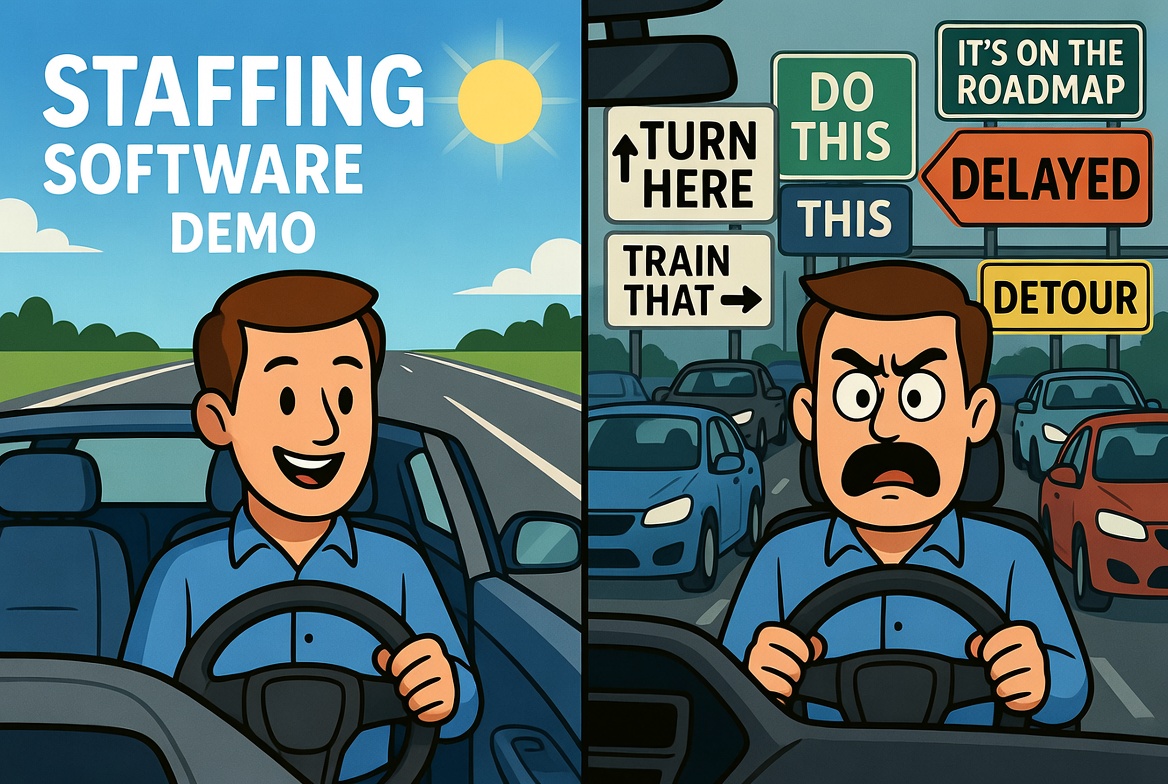
Staffing software doesn’t fail because the demo was bad.
It fails because the demo showed the happy path, and staffing companies do not live on the happy path.
They live in exceptions.
A candidate applies twice. A client changes the bill rate after the assignment starts. A recruiter forgets to update a field. Payroll needs one version of the truth, sales needs another, and ownership wants reports that explain why revenue is not growing fast enough.
That is where software either becomes a system or becomes another place people have to enter data.
And that is the part most staffing firms underestimate when they buy.
The Obvious Pain Is Easy to Name
The current system is slow. Too many screens. Too many clicks. The ATS does not talk to payroll. Payroll does not talk to billing. The job board feed is clunky. Testing sits in another tool. Onboarding sits somewhere else. Documents live in email, shared drives, or someone’s desktop folder called “New New Final.”
Over time, the company ends up with a Frankenstein stack:
- One system for front office
- One system for back office
- One system for testing
- One system for onboarding
- One system for texting
- One system for reporting
And because none of them cleanly agree with each other, people become the integration layer.
That is when software starts stealing time from the work.
Recruiters are supposed to be placing people. Salespeople are supposed to be talking to clients. Service teams are supposed to be solving problems before they become account issues.
Instead, too much of the day disappears into updating fields, switching screens, chasing duplicate records, hunting missing documents, and explaining why the report does not match what actually happened.
Where Software Switches Stall
The demos look better. The new platform appears cleaner, faster, and more modern. Then the hard questions arrive.
- Who owns implementation?
- Who cleans the old data?
- Which workflows are real, and which ones only exist in the training manual?
- Who decides what has to change: operations, finance, recruiting, sales, or ownership?
- What happens when the new system reveals that every branch has been doing things differently for years?
These are not software questions. They are organizational questions. And staffing firms often discover them too late.
Switching software is not just a technology decision. It is a power decision. It forces the company to define how work should actually happen. It asks people to give up side processes, private spreadsheets, personal shortcuts, and informal workarounds that may have been holding the business together.
That is why resistance is often rational.
A recruiter may not trust the new system because the old one, painful as it was, had known flaws. A payroll manager may worry that one bad migration could create a serious pay issue. A branch manager may fear losing local control. Sales may worry that more required fields will slow down order entry. Ownership may want better reporting without realizing the data behind those reports has to come from someone’s daily behavior.
The Real Cause of Failed Adoption
The blockage is rarely “people don’t like change.” That explanation is too simple.
The real blockage is that people do not like being handed new obligations without seeing what gets removed.
If a new system adds five tasks and removes two, users will reject it — even if leadership calls it progress.
If the software improves reporting but slows down recruiting, recruiters will work around it.
If implementation is treated like an IT project instead of an operating model change, adoption will look fine in meetings and fail quietly in the field.
That quiet failure is the dangerous part.
People may log in. They may attend training. They may say they understand the new workflow.
Then they keep the real process outside the system.
They text candidates from personal phones. They track hot prospects in spreadsheets. They write notes in places no one else can see. They move fast around the software because moving through the software feels too slow.
From the outside, the company has implemented a new platform. Inside, the business is still running on memory, habit, and exception handling.
What the Buying Decision Is Actually About
The buyer is not just choosing features. They are choosing which behaviors will become standard. They are choosing which data matters. They are choosing how much friction users will tolerate. They are choosing whether the system will support the work — or simply audit it after the fact.
The best software decision is not always the one with the longest feature list. It is the one that forces the right internal conversation before the contract is signed.
Ask these questions first:
- How do we actually work?
- Where do we lose time?
- Where do errors enter the process?
- Which tasks create value, and which ones only exist because the current system is badly stitched together?
- What does each role need to do its job faster, cleaner, and with fewer handoffs?
Those questions matter more than most demo checklists.
The Real Cost of Bad Staffing Software
The cost is not just the subscription fee.
It is recruiter frustration. It is payroll risk. It is client confusion. It is missed follow-up. It is dirty data. It is managers making decisions from reports that no one fully trusts.
And eventually, it is growth that stalls because the operating system of the business cannot keep up with the ambition of the owners.
Staffing firms do not need software that looks good in a controlled demo. They need software decisions grounded in the messy reality of how staffing actually works.
Because sometimes the real problem is not the software. Sometimes the problem is that the software reveals how much of the company was being held together by workarounds.
At KinISO, we build staffing back-office software around operational reality — not the happy path. Request a demo to see the parts other vendors skip.