AI is everywhere, but the breathless rush towards AI everything is starting to recede, as companies start asking the real question… is this making us money?
We’ve long been advocates of humans doing human things, and in our world, the best way to get someone onsite is to build a relationship with them.
AI screening and automation and lead generation has its place, but for the 60-70% of the workforce that is showing up in person, you need that human contact.
Temporary staffing has always moved fast. Clients need someone tomorrow, sometimes today, and the whole business runs on a recruiter’s ability to make a confident judgment call under real pressure.
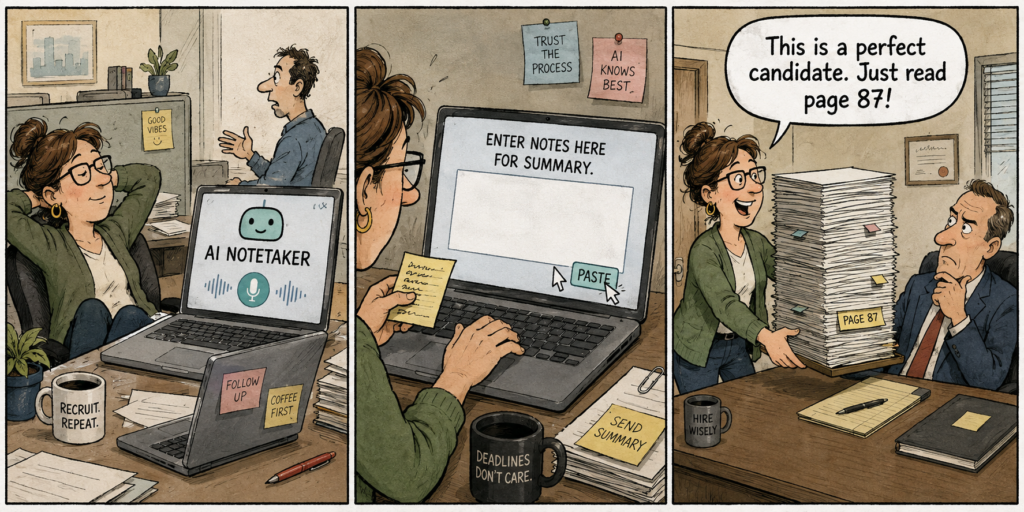
That pressure is exactly why the industry keeps gravitating toward technology that promises to speed things up — AI interviews, automated candidate scoring, systems that can rank a hundred applicants before a human ever gets involved. On paper, the efficiency math is attractive.
But there’s a structural problem with the idea that a machine can do the interviewing for you. It misunderstands what the interview is actually for.
You’re not filling a role. You’re vouching for a person.
In direct hire recruiting, a bad placement is a setback. In temporary staffing, it’s a reputation event. Your worker is on-site, representing your client’s brand, hours after you made the decision to send them. If they don’t show up, show up late, or create conflict on the floor, that reflects on you — not in some abstract sense, but immediately and specifically.
So the real question a recruiter is answering isn’t just “can this person do the job?” It’s: will they show up? Will they handle themselves well? Will they represent us the way we need to be represented?
Staffing firms historically brought workers into an office before placing them — not primarily to verify credentials, but to meet them. The skills check was almost secondary to something harder to name: do I trust this person enough to put them in front of a client?
The signals that actually matter don’t survive automation
When two people speak — in person, over video, even by phone — they’re exchanging information that never appears on a resume. Tone of voice. Whether someone makes eye contact or avoids it. Whether they lean forward when they’re engaged or seem checked out. The slight hesitation before an answer that tells you they’re actually thinking, not performing.
Researchers call this nonverbal communication. In recruiting, it shows up as something simpler: a gut sense of trustworthiness that experienced recruiters have learned to calibrate over hundreds of placements.
None of this is mysticism. It’s pattern recognition built on human social wiring that evolved over hundreds of thousands of years. A video chat activates it. A text response to an AI prompt doesn’t.
Automated interviews teach candidates to game the system
There’s another problem that doesn’t get talked about enough: when hiring becomes a technical system, candidates start trying to beat the technical system. This is already happening with resume keyword optimization and AI-generated application responses. If it becomes common knowledge how an AI interviewer scores answers, candidates will optimize for the score rather than reveal who they actually are.
It’s much harder to game a human conversation. Looking someone in the eye — even through a camera — creates social accountability. People instinctively respond differently when another person is present and paying attention. That difference is a feature of the process, not a limitation to engineer around.
Trust is also what keeps workers engaged
There’s a side of this that gets overlooked in efficiency-focused conversations: the worker’s experience matters too. A recruiter who took ten minutes to actually talk to someone, understand their situation, and explain the assignment creates a different kind of commitment than an automated process that pinged them with a scheduling link.
Workers show up because they respect the recruiter who placed them. They choose one assignment over another because of how the conversation made them feel. They stay longer because there’s a person on the other end of the phone who they trust. These aren’t soft factors. They’re the foundation of reliability — which is the entire product temporary staffing firms are selling.
When hiring becomes fully transactional, that emotional commitment evaporates. And worker engagement tends to follow it out the door.
So what should AI actually do in a staffing firm?
Quite a lot — just not the interview. The best staffing technology removes the administrative friction that keeps recruiters from doing the work that actually matters. Tracking candidate availability, managing job orders, automating onboarding paperwork, maintaining compliance documentation, running payroll — all of that is real overhead that genuinely benefits from automation.
The goal of good staffing software is to move faster toward human interaction, not eliminate it. Every hour saved on data entry is an hour a recruiter can spend talking to candidates and building client relationships. That’s the right trade.
AI will also get genuinely useful for things like candidate matching, searching across large talent databases, and improving recruiter productivity in ways that are hard to anticipate yet. The trajectory is real. But the most valuable applications will be ones that help two humans connect faster and more effectively — not ones that try to cut a human out of the connection.
At the end of the day, staffing isn’t just job-filling. It’s putting one person’s reputation into another person’s hands. That decision has always been human. The best technology doesn’t change that. It just gets you to that moment faster.
Frequently asked questions
Can AI replace human interviews in temporary staffing?
Not effectively. Temporary staffing relies on human judgment, trust signals, and interpersonal accountability in ways that automated scoring can’t replicate. AI tools can help recruiters work faster, but the interview itself needs to stay human.
Why do human interviews matter more in temp staffing than in direct hire?
The decision cycle is compressed and the stakes are immediate. A placed worker is on a client site within hours or days, representing the staffing firm’s reputation directly. There’s no long onboarding period to catch problems — the judgment call has to be right from the start.
How can AI help staffing firms without replacing recruiters?
By handling everything that isn’t the interview: candidate search, scheduling, compliance tracking, onboarding workflows, and payroll administration. The goal is to free up recruiter time for relationship-building, not replace the relationships themselves.
What tasks should staffing software automate?
Administrative work: onboarding documentation, compliance tracking, assignment scheduling, payroll management, and client relationship records. Anything that currently pulls a recruiter away from a conversation is a good automation target.